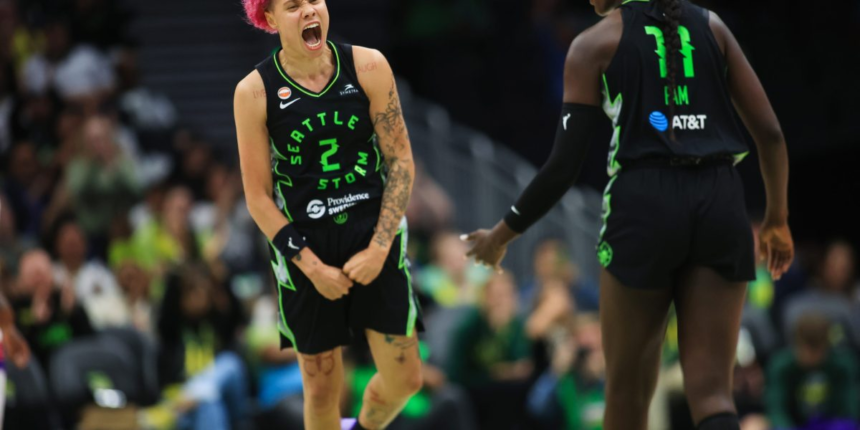
In the first eight years of the Seattle Storm’s existence, the WNBA team was the “tail” on the “dog” of its NBA counterpart, the SuperSonics, according to Storm co-owner Ginny Gilder.
While the Sonics were the foundation of basketball in Seattle, Gilder and the rest of the Storm’s ownership spent the last 16 years building the very basketball culture the NBA now wants to re-enter. To them, the return of the Sonics is not just an opportunity for the Storm to celebrate the transformation of women’s sports as the main act; it’s the chance to grow Seattle as a sports town, period.
“It raises the profile of basketball even more…so that you’ll now have pro-basketball pretty much 12 months a year in Seattle,” Gilder told Fortune. “It’s the Sonics and the Storm; it’s the Storm and the Sonics. It’s bread and butter, apple pie and vanilla ice cream. They belong together.”
“I got my degree in history, but I majored in equity, in access to opportunity,” Gilder said.
Though a New Yorker by birth, Gilder became a Storm fan in 2005, the year after the team won its first championship.
“I loved what the team represented,” she said, “And I loved the opportunity to try to make something happen on a more global scale, not be satisfied with the status quo.”
Their basketball knowledge varied greatly—Gilder admitted she didn’t know what a point guard was at the time—but the group had convictions about feminism and gender parity, as well as the financial resources to make sure Seattle could retain one of its basketball franchises. They vowed to run the team like a business.
“Women’s sports was in a very different place,” Gilder said. “And one of the things I said was, one day, we need to be able to sell our team for a profit—not because I wanted to make millions of dollars—but in America, you either have a charity or a hobby or a business.”
Unlike an NBA team, where market growth was assumed, owning a WNBA franchise required a different set of strategies, especially with no other basketball counterpart to bolster an audience or share costs.
Three more championships under Bird helped keep the team’s momentum high, and the new Climate Pledge Arena and training facility (designed by Spero Valavanis, the father of Storm CEO and president Alisha Valavanis) helped provide the team with the resources to grow. The team’s owners have said their social justice convictions struck a chord with Seattle’s sports fans.
With an anticipated, though not guaranteed, return of the Sonics, Gilder does not see the Storm anchoring the returning franchise in the same way the old Sonics did in the WNBA team’s early days. But while the Storm has become the dog, “I cannot imagine that the Sonics will be a tail.”
“Women’s sports has grown to a place that it has its own distinctive characteristics, it has its own fan base,” Gilder said. “That’s not going to go away with the return of a very important part of Seattle’s history.”
Should the Sonics rejoin the Storm, Silver expects “multiple bidders” for the team, as well as the need to address inevitable logistical hurdles. The Storm currently share Climate Pledge Arena with the Kraken, who have majority ownership of the building.
Natalie Welch, an assistant professor of marketing at Seattle University, said that while the Storm has allowed Seattle to maintain and grow its basketball fanbase ahead of the Sonics’ possible return, the Sonics will also provide a surge of demand for the Storm.
“The Sonics are going to be a hard ticket to get for a while and not as accessible,” Welch told Fortune. “The Storm will have an opportunity to kind of capture some of that value.”
WNBA fans often enjoy a less corporate experience than men’s basketball, Welch noted, and as the league grows and attracts more sponsors, there’s the added responsibility of keeping fans—including the Seattle faithful—top of mind.
“These even newer teams have been really interesting to see how they are walking the line of giving the hardcore fans and the longtime fans [what they want], plus trying to welcome in the new fans as well,” Welch said.