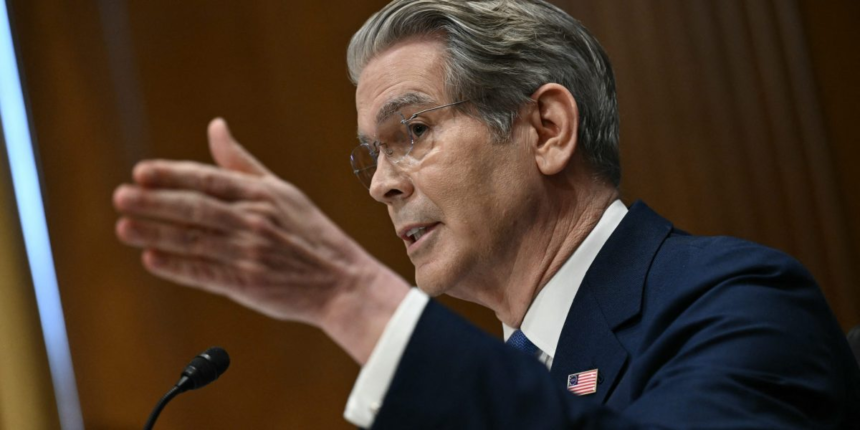
At Treasury Secretary Scott Bessent’s testimony before Congress on Wednesday, Sen. Bill Cassidy (R-LA) brought up a well-worn data point: 10,000 Baby Boomers enter Social Security every day. “In our plan,” Bessent vowed, “the senior citizen does not pay more taxes and the senior citizen does not get less benefits.”
Cassidy, who will be leaving the Senate fresh off a primary defeat by a Trump-backed candidate, waved what he called a “big spreadsheet” projecting that solutions being floated are “inadequate to address the problem.” Confronting Bessent with the Trump administration’s apparent lack of a plan, he reminded Bessent of an earlier visit to the Treasury secretary’s office, where the two had reviewed projections on a screen. “This is just incredible. It’s just going down.”
Bessent’s answer was to zoom out. The United States, he told the panel, does not have a tax‑collection problem. “We have a growth problem and a spending problem,” he said, arguing that a stronger Trump economy—not higher taxes or benefit cuts—is how Washington should manage a $39 trillion national debt and an aging population.
That diagnosis has become central to Bessent’s pitch: faster growth and tighter control of “wasteful” spending will stabilize the nation’s finances and preserve Social Security and Medicare without touching benefits. The hearing exposed how much now depends on whether that bet pays off.
Bessent acknowledged the demographic squeeze but stuck to his core theme. “The more Americans who work, the more the higher‑paying jobs they have, the more goes into [the] Social Security trust fund,” he replied, framing robust job and wage growth as the administration’s main response to the looming shortfall rather than benefit cuts or higher payroll taxes. When pressed on whether there is any plan beyond that indirect fix, he did not unveil a new proposal. Instead, he drew clear red lines: under the White House’s criteria, “the senior citizen does not pay more taxes and the senior citizen does not get less benefits.”
Democrats on the panel countered that the arithmetic is already moving the other way. They pointed to deficits that remain elevated even in a period of solid growth and to interest costs that have surged as more debt is rolled over at higher rates. They argued that Trump’s own fiscal choices—permanent tax cuts, higher defense and industrial spending—are a major reason the numbers on those Social Security spreadsheets look so daunting. In their view, leaning on growth while ruling out tax increases and benefit changes leaves a widening gap between promises and the underlying projections.
Trump’s own policies make Bessent’s assurances a harder sell. The latest Medicare trustees’ report shows the Hospital Insurance trust fund now projected to be exhausted in 2040, four years earlier than expected just a year ago, with the fund’s deterioration tied in part to weaker payroll and income‑tax flows after Trump’s tax cuts. At that point, incoming revenue would cover only about 92% of scheduled benefits unless Congress acts, and Social Security’s main trust fund faces its own sizable shortfall under current law.
Asked directly whether the White House would consider any steps beyond growth—such as higher payroll taxes, benefit trims, or structural changes modeled on other public pension systems—Bessent drew clear red lines. He said the administration would “work on anything” to strengthen the program — except any tax hike or benefit cut. That stance effectively rules out the two most powerful tools budget experts (such as the CRFB) usually cite for closing Social Security’s long‑term shortfall. It also aligns with President Trump’s frequent promise to “always protect” Social Security, Medicare, and Medicaid.
Some Republicans admit that something will have to give, and soon. Sen. Ted Cruz recently spoke about the Treasury’s “Trump Accounts” initiative to encourage more Americans to invest in the stock market.
Cruz confirmed that it’s true, in a sense. For 50 years, he said, conservatives have been trying to mimic Australia’s superannuation program, in which employers pay into an employee’s investment fund to be accessed upon retirement. Could that be the growth-and-spending fix that Bessent sees as solving the problem? Every day, 10,000 Baby Boomers will have to wait and see.