There’s no clear connection between the president’s comments, in a conversation with Fortune, and the delay, announced by the regulatory body, the U.S. Surface Transportation Board (STB), on May 28. A pause is not unexpected for such a huge acquisition.
The White House and the STB did not respond to multiple requests for comment on the topic of a potential government ownership stake, nor did Union Pacific or Norfolk Southern.
David Vernon, senior transportation analyst for Bernstein, said the government successfully negotiating a federal stake as part of the merger process is “probably not going to happen.”
“It would depend a lot on what the terms are,” Vernon said, allowing that some arrangement could potentially be worked out regarding the federal government investing in Union Pacific for specific growth that enhances U.S. economic security, such as expansions that UP wouldn’t normally undertake on its own.
The analyst said that whatever form the investment might take, making the acquisition deal contingent on giving the administration getting a stake would be highly unusual. “‘Write a check to get your merger approved’ seems less palatable,” Vernon said. He then paused, before adding: “I guess that’s possible.”
During a sit-down interview with Fortune on May 12, the president said that he wanted the government to gain an ownership stake in a pending railroad merger.
“I got another one coming, a railroad,” Trump said, of a deal that was currently in the works. “They want to expand. They want to merge, very big railroad, they want to merge. And I say, ‘Well, I want 15% of the railroad if you’re going to merge.’”
The companies declined, Trump told Fortune editor-in-chief Alyson Shontell, but he argued they will reconsider. “So they said ‘No,’ but they’ll say ‘Yes.’”
The Union Pacific-Norfolk Southern merger, which was first proposed last summer, is not facing an antitrust review under the purview of the Federal Trade Commission, as would be the case with most industries. Congress specifically exempted the freight railroad industry from FTC review, designating it to be regulated by the more specialized STB. While the FTC analyzes whether a merger lessens competition, the STB uses a broader “public interest” standard regulating “common carriers” in a concentrated but critically important industry.
In January, the STB rejected the initial application for Omaha-based Union Pacific’s $85 billion acquisition, including debt, of Atlanta-based Norfolk Southern in a cash-and-stock deal. The regulator said the application was incomplete and required a more thorough analysis on railroad congestion, the potential impact on commodities transported, pricing, and other factors.
On May 28, the STB accepted the revised application, which formally allows the deal to continue the acquisition process. But it also said that even more review is needed, triggering the temporary pause.
The STB said: “There are several aspects of the revised application that are unclear or underdeveloped and require supplementation at this stage of the proceeding so that the board may have the information necessary to thoroughly evaluate—and the public has an adequate opportunity to comment on—whether the transaction is in the public interest.”
“In a future decision, the board will establish an appropriate procedural schedule for the remainder of the proceeding,” the STB added.
The little-known STB has only three board members. Trump appointed two of them—chairman Patrick Fuchs and Michelle Schultz. The third, Karen Hedlund, served in the Obama administration and was appointed by former President Biden.
The federal government hasn’t owned any freight railroads since the 1920s, with the exception of the Alaska Railroad, now owned by that state. The government does hold majority ownership of the passenger rail Amtrak network.
Canadian Pacific’s regulatory argument at the time was that the two smallest North American railroads should be allowed to merge because their networks do not overlap and they connect neatly in Kansas City, Mo. The UP-NS deal, by contrast, involves UP, already the biggest publicly traded railroad, growing larger.
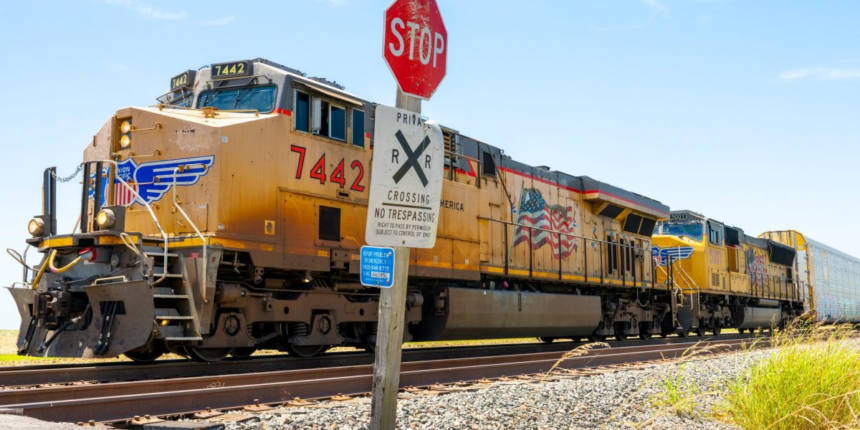
Union Pacific CEO Vena expressed confidence, in a prepared statement on May 28, that the deal will still be approved by mid-2027 as planned.
“We are confident this merger will deliver more reliable and lower-cost transportation options for American businesses,” Vena stated. “We submitted a comprehensive, data-driven application backed by a detailed plan for seamless integration. We look forward to the opportunity to show the facts and demonstrate the benefits for our customers, employees and America.”
The merger would create by far the largest railroad on the continent, with a combined enterprise value of $250 billion, 50,000 miles of rail across 43 states, and connections to roughly 100 ports and “nearly every corner of North America.” Vena contends the merger would create a stronger alternative to long-haul trucking, removing more than 2 million truckloads from roads annually.
But political and industry pushback is mounting. Senate Minority Leader Chuck Schumer, D-N.Y., has said the deal would push “us even further down the road of dangerous consolidation and monopoly power.”
“Right on cue, the companies are already making the same tired claims: this merger will promote competition, improve service, benefit workers and customers alike. History tells us the opposite,” Schumer said.
He framed the approval process as a test for the STB and the Trump administration: “Will they side with the railroad oligarchs, or will you side with workers and families? If Donald Trump rubberstamps another merger that hands over critical infrastructure to a corporate cartel, he’ll prove once again that he’s not on the side of working Americans.”
The Stop the Rail Merger Coalition, formed in late April, is also fighting the deal. Its members include Union Pacific’s archrival BNSF, CPKC, employee unions for both Union Pacific and Norfolk Southern, the Teamsters, and industry lobbying groups for the petrochemical and agriculture sectors.
“If allowed to move forward, the deal would create the largest consolidated railroad in U.S. history and give a single entity control over almost half of the nation’s rail traffic,” the coalition said.
“UP and NS have once again submitted an extremely flawed proposal,” the coalition added in a May 28 statement. “They have overstated benefits, minimized harms, and left critical questions unanswered. This merger is a bad deal for America and must be rejected.”
BNSF CEO Katie Farmer said the merger would “eliminate competition, raise costs for consumers, and destabilize the supply chain that powers the American economy.”