“The Super El Nino will further worsen the economic pain inflicted by the ongoing energy crisis,” says Ming Yi, a physical climate scientist and visiting professor at the National University of Singapore (NUS). “Asia’s electricity supply will be further strained as droughts curtail hydropower generation; farmers will be hard hit, and water-intensive manufacturing sectors like semiconductor and textile may also be disrupted.”
“This intense thermal surge acts like a turbocharger for the planet’s weather, amplifying normal seasonal shifts into severe global disasters,” Justin Sentian, a professor of climate change and atmospheric science at Universiti Malaysia Sabah (UMS), explains. Southeast Asia and India are among the economies most exposed to El Nino’s effects, due to their reliance on climate-sensitive sectors like agriculture, fishing, and hydropower. For example, the World Bank estimates that fisheries contribute 2.6% of Indonesia’s GDP and over 7 million jobs.
The 1877 Super El Nino, the strongest since records began, caused widespread droughts and monsoon failures in India and China. “Millions of people were thought to have died or been brought to the poverty line across Asia,” says Fiona Clare Williamson, an environmental historian from the Singapore Management University (SMU) who studied the impacts of El Nino drought events in 1877, 1902 and 1911. (In fact, it was these incidents that pushed researchers to identify the climate patterns eventually dubbed the “El Nino-Southern Oscillation.”)
Power use also increases during a heatwave. “Extreme ambient heat could cause immense strain on municipal power grids forced to bear the weight of surging air conditioning demand,” says Steve Yim, the director of the Centre for Climate Change and Environmental Health at Singapore’s Nanyang Technological University (NTU).
Sentian also points out that intense heat and intermittent water supplies could increase the risk of mosquito-borne diseases like malaria and dengue. “Desperate residents could inadvertently create breeding grounds by stockpiling water in buckets,” he says.
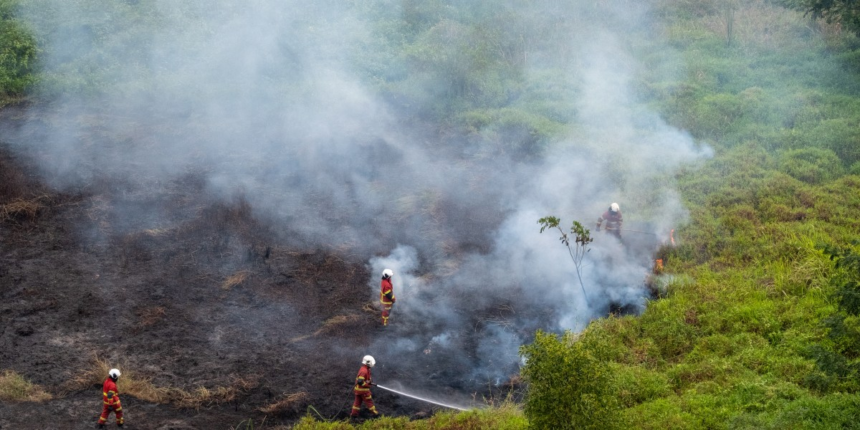
Forest fires in Sumatra and Kalimantan can also blanket neighboring Malaysia and Singapore in haze. Poor air quality will exacerbate chronic respiratory conditions like asthma, while forcing schools and businesses to close.
Sentian warns that the frequency of Super El Nino could double over the coming century, thanks to climate change. “The greenhouse-warmed ocean surface heats up faster than its deeper layers, making it significantly easier to trigger a massive thermal discharge into the atmosphere,” he explains.