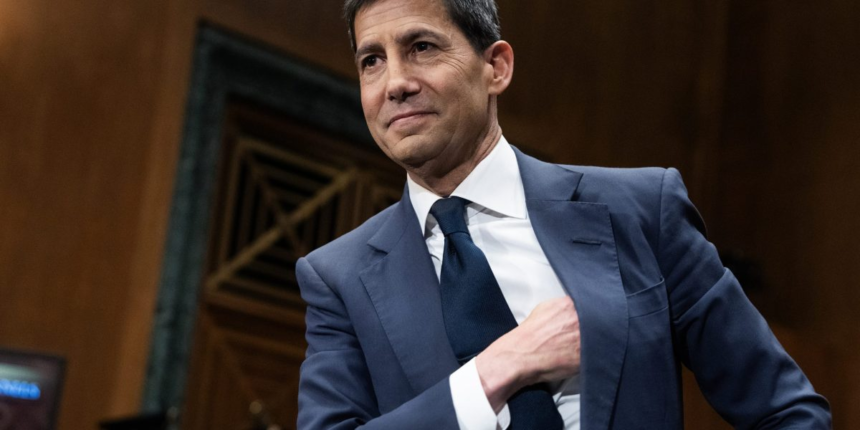
Warsh, 56, a former top Fed official, was confirmed Wednesday in a largely party-line 54-45 vote and will replace Jerome Powell as chair at an unusually difficult time for the independent agency.
Senate Majority Leader John Thune, R-S.D., said in a floor speech that it’s critical that a Fed chair “understand not only the macro” but also “appreciate the microeconomy: and that’s the hardworking Americans, their jobs and their livelihoods.”
“Kevin Warsh is just such a person,” Thune said.
“Obviously, data driven,” said Hassett. “I’m not putting any pressure on Kevin Warsh.”
In December, Trump said on his social media platform that he wanted a Fed chair who would cut interest rates when the stock market rose — the opposite of what traditional economics would prescribe — and added, “Anyone that disagrees with me will never be the Fed chairman!”
Still, Warsh denied at the hearing that Trump had pressured him to reduce the Fed’s key rate.
“I will be an independent actor if confirmed as chair of the Federal Reserve,” he said.
Warsh has been highly critical of the Fed’s recent track record, particularly the inflation spike in 2021-22, the worst in four decades.
He has called for limiting the Fed’s communications, which would be a sharp shift after decades of growing transparency. He has argued that some of its communications tools, such as quarterly forecasts of where its key rate may head, have made it harder for officials to switch gears.
“He will be the wealthiest Fed chair in history, but he refuses to provide transparency to the American people about who he is entangled with,” Warren said.
The Fed is tasked by Congress with keeping prices stable, which it seeks to do by raising its short-term rate to make borrowing and spending more expensive, cooling growth and inflation.
The Fed typically looks past temporary price increases that stem from supply disruptions, such as the war’s cutoff of oil through the Strait of Hormuz, because those prices typically level off — or even fall — once supply is restored.
But the Fed also followed that approach after the coronavirus pandemic snarled global supply chains. Inflation turned out to last longer than expected, and Powell and other Fed officials have acknowledged that they waited too long to raise rates. Inflation surged to 9.1% by June 2022.
A fourth member of the 12-member committee, Stephen Miran, dissented in favor of a rate cut, as he has at every meeting since Trump appointed him to the Fed’s board last September. Miran is serving until a replacement is named, and Warsh will take his spot.
U.S. Attorney Jeanine Pirro has dropped the government’s probe, but she has said it could be reopened if the Fed’s inspector general, which has looked into the renovation project since last July, finds evidence of criminal activity. ___