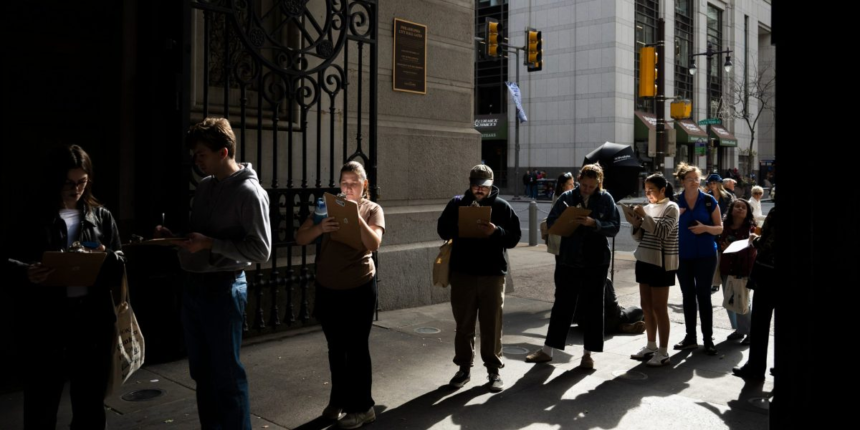
The laid-off factory worker from Youngstown, Ohio, became the defining figure of American politics for the past two decades. The jobless financial professional from Philadelphia’s suburbs could be the defining figure of the future, and their demands may be harder to ignore.
Bhaskar Chakravorti, the dean of global business at Tufts University’s Fletcher School and the study’s lead researcher, said that with the proper organization, these workers will become a stronger political force than any the U.S. has seen in recent decades. This geographical concentration, which he terms the “Wired Belt,” includes the suburban rings surrounding America’s biggest metros, many of which exist in swing states.
The study estimates that 9.3 million jobs are vulnerable to AI automation across the country. That amounts to a towering $200 billion in lost income. In an extreme scenario where AI is able to replace a larger share of labor, that figure rises to $1.5 trillion.
Chakravorti’s research identifies several primary clusters with a high concentration of knowledge-driven work, including metros like San Jose, Seattle, Boston, and New York. These areas face 3.5 times the job loss and over five times the income loss compared to traditional manufacturing regions.
But the real political punch lies in the suburban rings of pivotal swing states, specifically around Philadelphia, Atlanta, Phoenix, and Detroit. These are the regions that everyone comes to know during each presidential election: Bucks County, Pa.; Gwinnett County, Ga., or Maricopa County, Ariz. They’re the spots with the biggest door-knocking efforts, where TV journalists swarm undecided voters and poll after poll shows a tightening race. All of that is because who takes the White House is most likely decided by voters in these regions. And it doesn’t take much. In 2024, Trump won Wisconsin by roughly 29,000 votes.
While many of the Wired Belt voters Chakravorti characterizes tend to lean Democratic, there was a shift to the right in the 2024 election. He said whichever party successfully offers a plan for greater human capital investment and a transition to an AI-driven economy that supports these disgruntled workers will hold the keys to these critical suburban districts in the midterms, and in 2028.
“There is an opportunity to just get those 100,000 voter swings in the swing states and the election, you know, could be operating in a way, you know, moving in a very different direction in terms of the outcomes.”
Whatever the case, Chakravorti predicted the mere threat of job loss could be enough to trigger a new political wave across suburban America.
“The threat should be enough to push people into action if they begin to start connecting the dots,” he said.