As Big Tech competes to win the AI race, America’s top universities are also clamoring for the best resources to study and research the technology. And the University of Southern California just got a massive bet from one of the country’s most prominent venture capitalists to place them squarely in the competition.
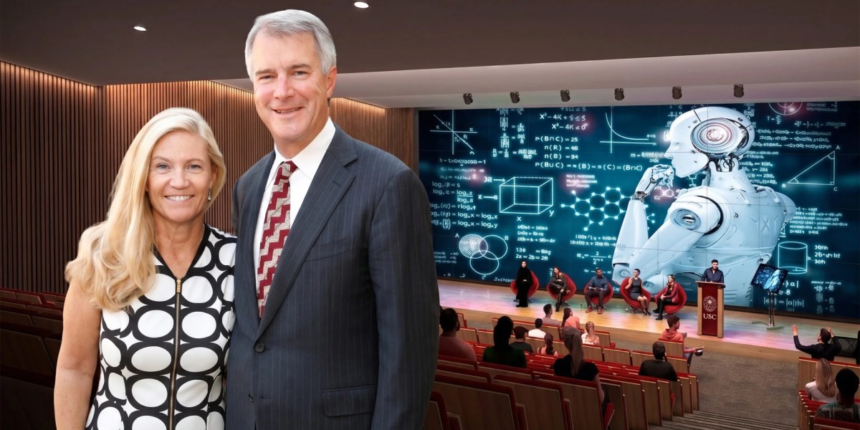
This marks one of the largest gifts in the school’s 146-year history. In recognition, USC’s School of Advanced Computing, housed within the Viterbi School of Engineering (one of the top engineering schools in the country), will be renamed the USC Mark and Mary Stevens School of Computing and Artificial Intelligence.
“As a top destination for AI talent, USC can accelerate our mission of educating future leaders, addressing real-world problems, and enhancing human values and agency,” USC President Beong-Soo Kim said in a statement.
The $200 million donation will fund the recruitment of AI researchers and back work spanning health sciences, security, business, and the arts.
“We know the next great universities will be those that invest in computing,” Stevens, who is also a USC alum, said in a statement. “This is a key moment.”
Stevens, 66, earned his bachelor’s degree in electrical engineering and economics from USC in 1981 and a master’s in computer engineering from the school in 1984, and went on to earn an MBA from Harvard Business School in 1989.
“Mary and I realized that we had more than enough wealth that we would ever need and began to think about what to do about it,” Mark Stevens wrote in his Giving Pledge letter. “There were four options: 1) give it to your kids (we have three), 2) let the government take it from you and redistribute it, 3) spend with reckless abandon or 4) donate virtually all of it to causes and organizations that we feel could make a difference in the world.”
“We are thrilled to devote a significant portion of our future time and energy to option four,” he continued.
“I think a lot of American universities are in danger of getting left behind if they don’t invest and raise money to further the AI revolution,” Stevens said. He also acknowledged the technology’s risks, adding “AI in the wrong hands … can be very destructive.”
“I think one of the jobs of universities in America is to understand, have a balanced approach, understand the guardrails and the safeguards that need to be adhered to as AI proliferates,” he continued.