Ed Bastian has a bone to pick with Silicon Valley’s marketing department.
The distinction matters in practice, Bastian argued, saying Delta has no intention of using AI as a headcount-reduction tool. “At the end of the day, we know those job skills are going to change, as it always has. But one of the things with AI is it’s changing more rapidly than people anticipate. And you’ve got a lot of hype around it.” We need to bring the pressure down, he said.
Where automation frees up Delta workers from gate phones or reservation desks, he said, those people are getting redeployed to serve customers more directly. “To the extent there’s less need for more people at a gate or more people on a phone, we’ll redeploy those people to better serve customers even more,” he said, adding that Delta has a “higher calling” to provide the best service and the best care, and strive to do it better, even against a punishing backdrop for air travel of late.
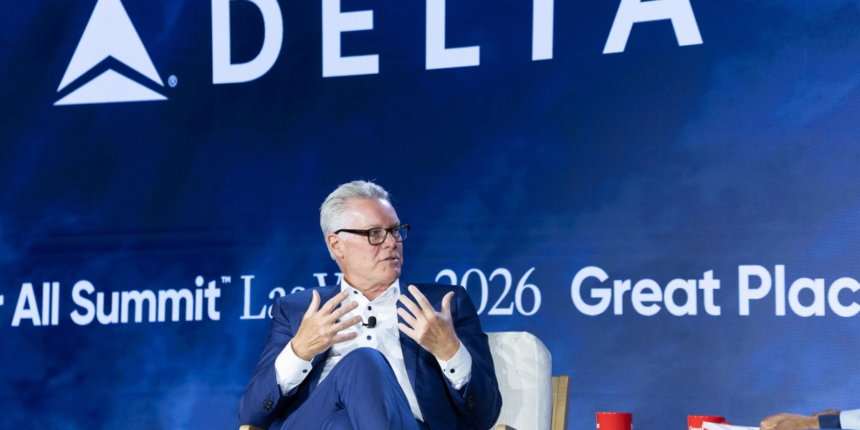
In conversation with Bush onstage at the summit, Bastian paused to stress that Delta is not just the world’s largest and most profitable airline, but also most beloved by its customers. Being on the Great Place to Work list and the Most Admired List tells Bastian, he said, “that we’re making progress on [our] mission.” At the same time, he stressed that only being number nine is below his standards. “I love it, but I’m not – I’m not happy.”
Bastian also said he’s frankly surprised that Delta continues to rank so highly, given the turbulence of the COVID and post-pandemic era. Over the last five years, he noted, Delta has brought in somewhere between 30% and 40% new employees — an enormous cultural stress test for a 100-year-old company. “I’m surprised — slash impressed — with our ability to continue moving up the levels of a great place to work, given that we’ve had such a large influx of new talent.”
The more revealing test of that covenant came during COVID-19. When the pandemic wiped out the airline’s revenue virtually overnight, Bastian told his leadership team he intended to get through it without laying off a single employee. “They looked at me like I’d lost my mind,” he recalled. More than 50,000 workers ultimately volunteered to take unpaid leaves of absence for up to two years, cutting Delta’s payroll in half overnight. “They sacrificed together to get the airline not just through COVID, but through COVID even stronger,” Bastian told Fortune.
This has fed directly into the airline’s current position and Delta thriving beyond the age of “revenge travel,” which he agreed was definitely a thing. But Delta is seeing something different, he said. “It was revenge travel initially. But now it’s no longer revenge travel. Now it’s turned into more of a lifestyle decision.” Bastian said his experience shows people aren’t as interested in accumulating things as in experiences, and that this will matter in the age of AI. “We live in the experience economy.” He cited the declining birth rate as another factor here. “Part of it is the cost and everything you’ve got to do as a father of four and a grandfather of two. I understand that. But in other things, people want to invest themselves differently.”
For all his talk of balance sheets and augmented intelligence, Bastian kept returning in both conversations to the same foundational point: culture is Delta’s only truly uncopiable competitive asset — and the company’s program around a $1,000 emergency savings fund is, in his telling, as much a product of the fortress mentality as any financial instrument.
The emergency savings program consists of $1,000 deposited into a personal bank account for each of Delta’s 100,000 employees, conditional on completing a financial literacy course and meeting with a financial counselor. It was born of the same logic that produced the fortress balance sheet: the idea that a financially fragile workforce cannot be durable. “If you’re paycheck to paycheck and all of a sudden you’ve got $5,000 sitting there, you feel better prepared to be your best self when you come to work,” Bastian told Fortune. More than 85% of recipients have never touched the principal, he added, and many have added to it. The math is blunt: $1,000 times 100,000 employees equals $100 million — a sum Delta committed while still clawing back from the pandemic. “[That was] at a time that we didn’t really have that kind of money because we were still recovering from COVID. But I thought it was that important.”
He added a firm line on one question AI will not answer anytime soon: “I’m never getting on an airplane without two Delta pilots on it commercially, and I don’t think that’s going to change anytime soon, even though I know the computers fly the planes in large respect today. People want to feel in control, and they want to see someone that’s in control of the experience.”