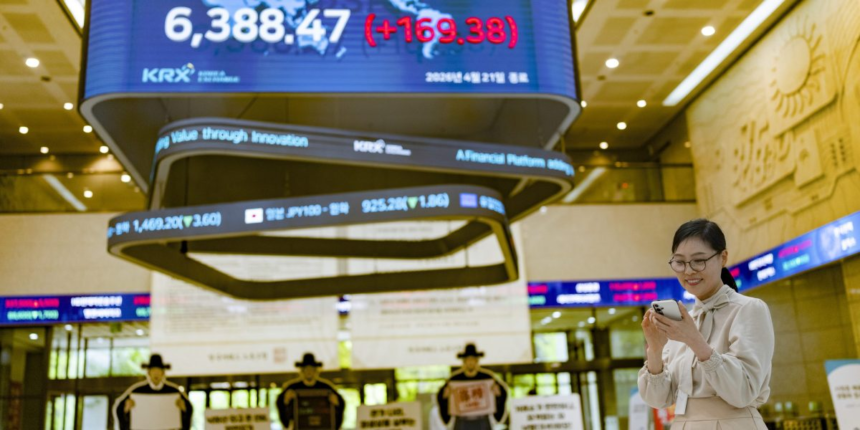
Asia’s stock markets have rebounded since the outbreak of the Iran war over two months ago, as the AI boom lifts the fortunes of manufacturing economies like China, South Korea, and Japan.
At the same time, the Middle East conflict is stoking fears of de-dollarization, sending investors in search of alternatives like the Chinese yuan.
Other Asian markets aren’t faring as well.
Buoyed by the AI trade, East Asian economies have largely erased their losses incurred when the war began. As of April 27, Taiwan’s Taiex is up almost 10% compared to pre-war levels, while South Korea’s KOSPI has risen by 4%. Japan’s Nikkei 225 and China’s CSI 300 have also inched upwards.
“Energy is still a dependency in Southeast Asia,” Aditya Laroia, CEO of Maybank Securities, says. “If you’re not producing it all domestically, then you’re naturally dependent on a lot of other parts of the world.”
He adds that political instability is also dampening investor confidence in parts of Southeast Asia. The Philippines, for example, saw a huge market sell-off in late 2025 following a major corruption scandal with government-funded flood-control projects.
“Wherever there’s instability in terms of government and policy, it’s detracted from capital flows,” Laroia says.
This has been reflected in weakening market indices in Asia’s emerging economies. Since the war began, India’s NIFTY 50 has fallen about 5%, while the MSCI ASEAN index is down by 7%.
AI and the Iran war do converge on one area, however: energy security. Data centers require immense amounts of electricity to run, boosting demand even as fuel supplies from the Middle East remain locked in the region.
This is where Southeast Asian nations like Indonesia, Thailand and Malaysia, are getting the chance to shine. They, alongside other ASEAN nations, are stepping up efforts to build out critical energy and AI systems within the region. “There’s a big infrastructure play in Southeast Asia,” Laroia says. “The investment of capital into energy sources and renewables will continue, and that’s why this part of the world still has a lot of growth left in it.”
“It’s really infrastructure that creates the biggest opportunity right now, from an investment perspective,” Chanana, of Saxo Bank, says.