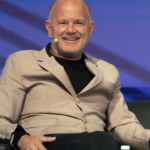
Gray is not yet CEO. But he is already doing a version of the job in social media feeds, and offering a preview of what the modern corner office now demands: a chief executive who doubles as a creator‑in‑chief.
“I was like, ‘Oh wow, that worked,’” he recalls. “I go to Japan, I go to Paris, I go to Bentonville, Arkansas. I can keep doing this.”
Gray’s posts are usually unpolished, slightly breathless—he is running, after all—and highly effective. His Blackstone team tells Fortune the operation is relatively low-lift: no coaching, no prep calls, no talking points laid out before he hits record. “It’s really just all him,” Blackstone’s Anderson tells Fortune.
It’s an effective communications strategy for Blackstone—and for Gray’s own profile as an executive—that also happens to be very cheap. “Obviously, the cost is not very high to go like this,” Gray says, holding up his phone. “And it works.”
While compliance rules for the financial firm’s external communications still apply, the legal inspection and green-lighting process generally takes just a few hours. Besides, “most of the time, I’d be jogging anyway,” Gray says. “It’s probably motivated me a little more, honestly.”
Part of Gray’s appeal is that he leans into his quirks. “There is a little bit of what I describe as my dorky dad vibes,” he says. “That’s maybe the way my girls would say it. But that’s sort of who I am, a little bit overly optimistic.”
His daughters are also some of his toughest critics. Gray often sends draft videos to both his family’s and Blackstone team’s group chats for review. “They have insights,” Gray says of his children. “They’ll say to me, ‘Hey, the background wasn’t so good,’ or ‘The lighting wasn’t so good,’ or ‘You should hold the camera better. You’re holding it down, you’re getting too much extra chin there.’ They’re much better at this stuff.”
Anderson says the magic lies in Gray’s willingness to poke fun at himself. “He’s uniquely good at this,” she says. “If you have a CEO who this doesn’t come naturally to, it’s very hard.” Gray’s lack of self-consciousness is an asset, he says: “If I stumble on some words, if I’m out jogging, sweating—the more authentic, the better.”
For executives hoping to copy Gray’s success, he offers a simple formula: “Good background, a bit of humor, self-deprecation is very good. And then if you can have a nugget of information, advice, or insights, and you wrap that together and try to keep it to 90 seconds or less, that’s what you’re trying to do, but it does have to be authentic.”
But he and Anderson have found that heavily produced studio content routinely underperforms in comparison to the spontaneous running clips. “If we do something highly produced, and we spend a lot of time in the studio, we reach fewer people,” Gray says. “Some of these [running videos] may reach more people than when we go on TV.”
While most of Gray’s videos appear to be spontaneous, there’s a genuine business strategy behind them, and it’s a playbook more Fortune 500 executives are scrambling to replicate.
“At the end of the day, in our business, when you’re investing capital on behalf of others, you’re a steward of capital, you’re really in the trust business,” Gray says. “Being able to communicate with your clients directly, your shareholders, and show them who you are and what matters to you in a direct way, that’s very helpful, and that’s what this has become.”
LinkedIn editor-in-chief Daniel Roth says Gray’s approach has become a model for other leaders. “There is a ton of demand for these executive voices because they’re authentic,” he says. “Executives trying to figure out how to be heard, in a very noisy market, see that other executives are having success doing it, and so they start doing it themselves.”
“Why does what time they wake up or when they do their workout matter to them doing their job?” he asks. “But that’s what people love, because we live vicariously through our heroes. Business executives increasingly, for better or worse, play that role in society.”
Given the positive reception on LinkedIn, it’s no surprise that other executives—and their communications teams—have taken notice, reaching out to Anderson, Gray says: “A lot of other firms [ask], ‘How did you get Jon to do this?’”
Gray says he has no plans to slow down anytime soon: “At some point, when I’ve jogged in enough places and people are like, ‘Enough already,’ we’ll find something else to do.”