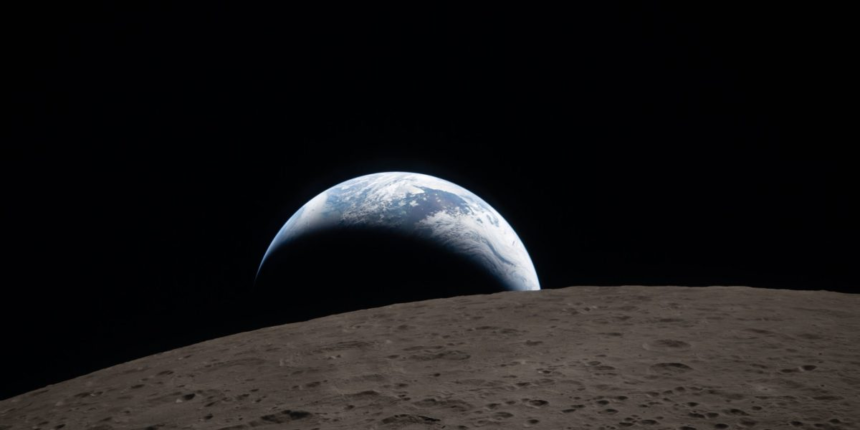
Never-before-glimpsed views of the moon’s far side. Check. Total solar eclipse gracing the lunar scene. Check. New distance record for humanity. Check.
Now that the first lunar travelers in more than a half-century are safely back in Houston with their families, NASA has Artemis III in its sights.
“The next mission’s right around the corner,” entry flight director Rick Henfling observed following the crew’s Pacific splashdown on Friday.
Musk’s Starship and Bezos’ Blue Moon are vying for the all-important Artemis IV moon landing in 2028. Two astronauts will aim for the south polar region, the preferred location for Isaacman’s envisioned $20 billion to $30 billion moon base. Vast amounts of ice are almost certainly hidden in permanently shadowed craters there — ice that could provide water and rocket fuel.
The docking mechanism for Artemis III’s close-to-home trial run is already at Florida’s Kennedy Space Center. The latest model Starship is close to launching on a test flight from South Texas, and a scaled-down version of Blue Moon will attempt a lunar landing later this year.
NASA promises to announce the Artemis III crew “soon.” Like 1969’s Apollo 9, Artemis III aims to reduce risk for the moon landings that follow.
Apollo 9 astronaut Rusty Schweickart loved flying the lunar module in low-Earth orbit — “a test pilot’s dream.” But there’s no question, he noted, that “the real astronauts” at least in the public’s mind were the ones who walked on the moon.
Wiseman and his crew put their passion and feelings on full display as they flew around the moon and back, choking up over lost loved ones as well as those left behind on Earth.
Artemis II included the first woman, the first person of color and the first non-U.S. citizen to fly to the moon.
“Wonderful communicators, almost poets,” Isaacman said from the recovery ship while awaiting their return.
Apollo’s manly, all-business moon crews of the 1960s and 1970s certainly did not do group hugs.
For those old enough to remember Apollo, Artemis — Apollo’s twin sister in Greek mythology — couldn’t come fast enough.
“It’s amazing how far we’ve come and how different this experience is from back then,” Chaikin said from Johnson Space Center late last week.
The hardest part, according to NASA Associate Administrator Amit Kshatriya, is becoming so close to the crews and their families and then blasting them to the moon. He anxiously monitored Friday’s reentry alongside the astronauts’ spouses and children.
“You know what’s at stake,” Kshatriya confided afterward. “It’s going to take risk to explore, but you have to make sure you find the right line between being paralyzed by it and being able to manage it.”
Calling it “mission complete” only after being reunited with his two daughters, Wiseman issued a rallying cry to the rows of blue-flight-suited astronauts at Saturday’s celebration.
“It is time to go and be ready,” he said, pointing at them, “because it takes courage. It takes determination, and you all are freaking going and we are going to be standing there supporting you every single step of the way in every possible way possible.”