The United States and Iran ended a historic round of face-to-face talks early Sunday without reaching an agreement and the fate of the fragile, two-week ceasefire still unclear.
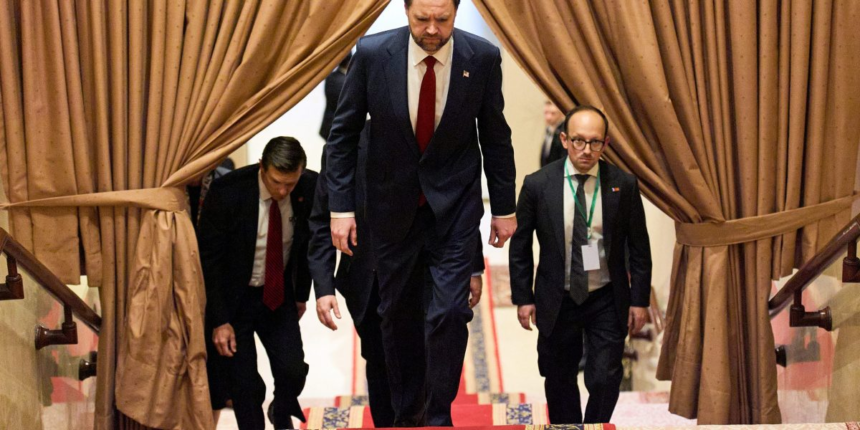
Vice President JD Vance, who led the U.S. delegation during the 21 hours of talks in Pakistan’s capital Islamabad, said negotiations finished without a deal after the Iranians refused to accept American terms to refrain from developing a nuclear weapon.
There was no immediate comment from the Iranian delegation, but Pakistani mediators called on both countries to maintain the ceasefire.
“It is imperative that the parties continue to uphold their commitment to ceasefire,” Pakistan Foreign Minister Ishaq Dar said, adding that his country will try to facilitate a new dialogue between Iran and the U.S. in the coming days.
Vance said he remained in constant communication with U.S. President Donald Trump and others in the administration during the negotiations.
“But the simple fact is that we need to see an affirmative commitment that they will not seek a nuclear weapon, and they will not seek the tools that would enable them to quickly achieve a nuclear weapon,” Vance told reporters. “That is the core goal of the president of the United States. And that’s what we’ve tried to achieve through these negotiations.”
The vice president said he spoke with Trump “a half dozen times, a dozen times, over the past 21 hours” and also spoke with Secretary of State Marco Rubio, Treasury Secretary Scott Bessent and Adm. Brad Cooper, head of the United States Central Command.
“We were constantly in communication with the team because we were negotiating in good faith,” Vance said, speaking at a podium in front of a pair of American flags with special envoys Steve Witkoff and Jared Kushner to his side. “And we leave here, and we leave here with a very simple proposal, a method of understanding that is our final and best offer. We’ll see if the Iranians accept it.”
Two Pakistani officials, who spoke on condition of anonymity because they were not authorized to brief the press, said a third round of discussions between the delegation heads had finished and the talks would resume after a break.
Then the U.S. vice president addressed the press, announced there was no agreement and went to the airport to leave Pakistan.
Trump had said he would suspend attacks against Iran for two weeks. Vance’s comments did not indicate what will happen after that time period expires or if the ceasefire will remain in place.
“We’re sweeping the strait. Whether we make a deal or not makes no difference to me,” Trump told journalists as talks continued and the time approached 2 a.m. in Islamabad. He called negotiations “very deep.” Iranian state TV noted what it called “serious” differences.
Since the Islamic Revolution in Iran in 1979, the most direct U.S. contact had been in 2013 when President Barack Obama called newly elected President Hassan Rouhani to discuss Iran’s nuclear program. Obama’s secretary of state, John Kerry, and counterpart Mohammad Javad Zarif later met during negotiations toward the 2015 Iran nuclear deal — a process that lasted well over a year.
Iran’s state-run news agency said the three-party talks began after Iranian preconditions, including a reduction in Israeli strikes on southern Lebanon, were met.
Iran’s delegation told state television it had presented “red lines” in meetings with Pakistani Prime Minister Shehbaz Sharif, including compensation for damage caused by U.S.-Israeli strikes that launched the war on Feb. 28 and releasing Iran’s frozen assets.
Iran’s closure of the Strait of Hormuz has proved its biggest strategic advantage in the war. Around a fifth of the world’s traded oil had typically passed through on over 100 ships a day. Only 12 have been recorded transiting since the ceasefire.
On Saturday, Trump said on social media that the U.S. had begun “clearing out” the strait.
“Today, we began the process of establishing a new passage and we will share this safe pathway with the maritime industry soon,” U.S. Central Command commander Adm. Brad Cooper later said. The U.S. statement about the destroyers added: “Additional U.S. forces, including underwater drones, will join the clearance effort in the coming days.”
Iran’s 10-point proposal ahead of the talks called for a guaranteed end to the war and sought control over the Strait of Hormuz. It included ending fighting against Iran’s “regional allies,” explicitly calling for a halt to Israeli strikes on Hezbollah.
The United States’ 15-point proposal includes restricting Iran’s nuclear program and reopening the strait.
But as thousands in Lebanon protested the planned negotiations on Saturday, Prime Minister Nawaf Salam said he had postponed a planned trip to Washington “in light of the current internal circumstances.” His absence should not affect talks as the first round is expected to be at the ambassadorial level.
___
Castillo reported from Beijing, and Finley and Binkley from Washington. Josh Boak in Washington, Samy Magdy in Cairo, Cara Anna in Lowville, New York, and Christopher Weber in Los Angeles contributed.