President Donald Trump’s war on Iran has raised doubts about America’s superpower status and currency dominance as the Strait of Hormuz remains under Tehran’s control.
But Dan Alamariu, chief geopolitical strategist at Alpine Macro, isn’t buying predictions about a U.S. decline: “Don’t Believe The Hype (Yet).”
In a note on Friday, he acknowledged that if Iran’s regime is left standing while retaining some control over the strait, it would represent a “strategic setback” for the U.S. and humiliation for Trump.
“The bigger question is whether this marks the end of American superpower status, dollar dominance, and the petrodollar. More possible if Iran ends up with control of the SoH, but we would not bet on it,” Alamariu added.
He also shot down comparisons to the Suez Crisis in 1956, when the U.S. pressured Britain and France to abandon their attempt to regain control of the Suez Canal, signaling the end of their reign as great powers.
Alamariu pointed out that the two European countries had effectively lost their empires by then after being bankrupted by World War II. “The U.S. does not resemble that.”
In addition, the U.S. defeat in the Vietnam War also gave rise to declarations of American decline, but it was instead the Soviet Union that ended up collapsing, he noted.
“Similarly, the petrodollar faces some increased risk, but the GCC has more reason than ever to keep ties with Washington close, given Beijing’s perceived closeness to Iran,” Alamariu wrote, referring to the Gulf Cooperation Council. “The idea of a petroyuan or petroeuro replacement remains far-fetched.”
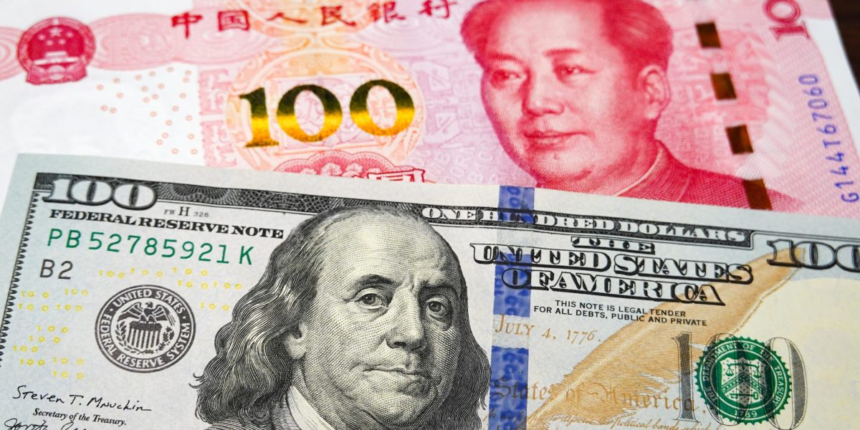
Wall Street analysts have highlighted that dollar dominance is anchored by the greenback’s use as the standard currency in the global oil trade.
For his part, Alamariu is also skeptical about Iran’s attempt to de-dollarize the oil trade with its current toll booth arrangement for the Strait of Hormuz.
“If anything, the GCC appears poised to resist Iran (with U.S. help) and accelerate bypass pipeline construction, should Iran retain control of the SoH,” he said. “Lastly, even Iran’s proposals for yuan or crypto-denominated Strait tolls are not meaningfully dollar-bearish; most stablecoins are effectively dollar-denominated instruments.”
Even if the petrodollar weakens, dollar dominance still rests on other factors that other currencies can’t match, according to Paul Blustein, a scholar at the Center for Strategic and International Studies.
“It accounts for well over half of foreign currency reserves held by central banks, and a similar share of export invoices for cross-border trade, as well as international bank loans and bond issuance,” Blustein added. “Network effects entrench its status; everybody has an incentive to use the dollar because so many others do.”