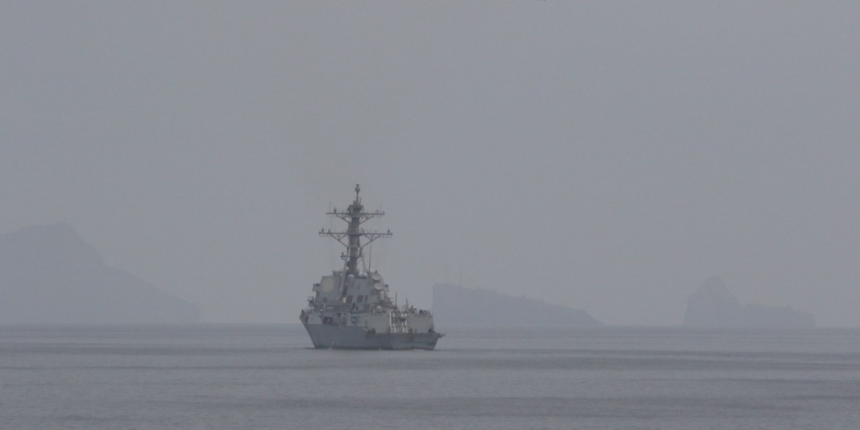
U.S. Navy ships sent an unmistakable signal Saturday as they crossed the Strait of Hormuz, challenging Iran’s control over the narrow waterway that will likely determine the outcome of the Middle East war.
The USS Michael Murphy turned on its automatic identification system as it and another destroyer, the USS Frank E. Peterson, transited the strait, breaking the typical protocol of Navy ships sailing with their AIS turned off.
U.S. Central Command said the destroyers had begun setting conditions for clearing mines that had been placed by Iran’s Islamic Revolutionary Guard Corps.
It added that more U.S. forces, including underwater drones, will join the clearance effort in the coming days, pointing out that the strait is an international sea passage and an essential trade corridor.
Iran’s grip on the strait, through which one-fifth of the world’s oil and liquid natural gas flowed before the war, has triggered a global energy crisis and represents the regime’s main form of leverage over the U.S.
The destroyers’ crossing of the strait comes as the U.S. and Iran began ceasefire talks in Pakistan this weekend. But if the Navy creates a safe avenue for tankers that doesn’t require getting Iran’s permission and paying a toll, then talks would shift in America’s favor.
“This is the last warning. This is the last warning,” the IRGC said.
“Passage in accordance with international law. No challenge is intended to you, and I intend to abide by rules of our government’s ceasefire,” the U.S. ship replied.
Meanwhile, the U.S. military continues to send more combat power to the region. A third aircraft carrier as well as thousands of Marines and paratroopers are expected to arrive later this month. More long-large cruise missiles are also flowing to the Middle East.
Mercogliano said there were earlier signs the Navy resupplied its ships via the island of Diego Garcia, potentially to replenish munitions. Littoral combat ships, which are equipped with mine-hunting underwater drones, may also be in the mix.
While it’s not clear if the destroyers entered the strait alongside those ships or without them, it still marked an important milestone for the oil trade.
“One of the things that commercial ships were waiting to see was whether or not this strait was clear, and sailing two destroyers in is a big one,” he added.
As the U.S. weakens Iran’s ability to threaten ship traffic, Iran’s leverage will erode, and conditions for a lasting ceasefire with a full reopening of the Strait of Hormuz could be in place later this month, he said.
McNally compared neutralizing Iran’s threats to a game of whack-a-mole, noting the variety of its weapons, and pointed out that the U.S. has reduced Iran’s stockpile of underwater mines.
“It may not be widely reported, but I believe the U.S. military in the last week or so has been focusing on whacking those moles, degrading Iran’s ability,” he added. “You may not perfectly get rid of it, but degrading Iran’s ability to interdict shipping down to a manageable level—and that’s when insurance can come into play and escorts, and folks can start to move through.”