The birth of ‘gunpowder warfare’ can be traced back to the 15th century and the invention of the matchlock gun, the first mechanical firing device. Now drone swarms attack across borders with impunity. In 1685, Giovanni Borelli, the Italian physicist, foresaw a world where machines driven by pulleys could ape the actions of animals. Elon Musk now talks of robots intelligent enough to do the shopping and take the place of surgeons.
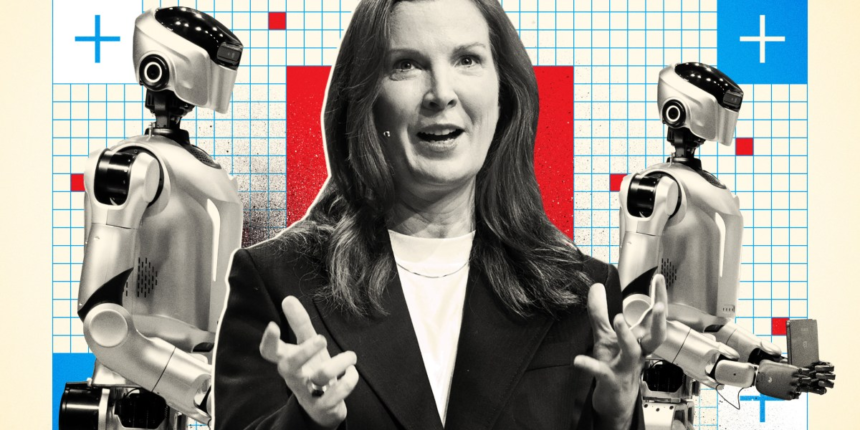
“What I find really interesting is, when people go into this installation, it helps you put this moment in perspective,” Kate Crawford told the Mobile World Congress in Barcelona in March. Crawford, artificial intelligence research professor at the University of Southern California, is the co-creator of the mural, which took four years to fabricate. With the visual artist, Vladen Joler, the work urges us all to consider who is making the rules and deciding what matters when it comes to fundamental technology shifts.
“People feel like we’re living in this technological presentism and crazy amount of change,” Crawford said. “So, the ability to step back and say, ‘what have we learned over 500 years?’ [matters]. For me, [the mural] was a transformative project, because what was very clear is that history is not just about technical innovation. It’s about who has the power to set the rules that we will be living within.”
“This is why agentic AI is so important right now, because it’s a rapidly evolving field. The standards are not yet set, and it’s going to be people here, in rooms like this, at places like Mobile World Congress, who are going to have these conversations—what do we want those standards to look like, how do we implement them in our systems, and how do we protect ourselves and our clients?”
“Because this is the big moment to actually make sure that this is a technology that is profoundly useful and helpful and not one that opens up vulnerabilities and attack vectors and new attack surfaces and actually could be cognitively really quite dangerous as well.”
MWC is also a place for debate. On large stages, the leading minds in the technology world have the conversations often lost among the flashing neon lights and interactive plasma screens. “Move fast and break things,” Mark Zuckerberg said in 2012. Today, the stakes are too high.
“What do we mean by intelligence?” Crawford asked. “The history of the term ‘intelligence’ is a troubled one. It’s been used to divide populations, to drive programs about who is valuable and who is not.”
“We’re trying to compare agents to human intelligence. They’re actually completely different. This [intelligence] is statistical probability at scale. These are systems that are following tasks in complex environments. This is very different to humans, but that means we need to have a different set of questions, which is: what are agents doing? How can we track that, and how can we better understand the way it’s going to change our own workflows and, much more importantly, how we live?”
“The history of the term ‘intelligence’ is a troubled one…”
As the debate continues about the tensions between OpenAI, Anthropic and the Department for War in America, Crawford asks what are the red lines for agent use? “Imagine agents in the battlefield,” she says. We do not need to. AI-enabled bombing ‘at the speed of thought’ has been reported to be happening in Iran. One of AI’s functions is ‘decision compression’, shortening time frames between idea and execution. The ‘kill chain’ is reducing.
“You’ve got scale and you’ve got speed, you’re [carrying out the] assassination-style strikes at the same time as you’re decapitating the regime’s ability to respond with all the aerial ballistic missiles,” academic Craig Jones at Newcastle University told The Guardian newspaper in the U.K. “That might have taken days or weeks in historic wars. [Now] you’re doing everything at once.”
“We are seeing a type of shell game where [people say] ‘is it the designer [who is responsible]? Is it the deployer? Is it the enterprise client? Is it the end user?’ And everyone can say, ‘well, we don’t really know yet’. That’s not going to be acceptable,” said Crawford. I think what we’re going to start to see in the conversation, particularly with regulators, is a very strong chain of accountability so you know exactly who is responsible when.”
If half of what was talked about at MWC 2026 comes true, agents will soon be involved in every aspect of our lives. They will be able to read and cache every half-written text, every deleted image, every email that was left in draft, every video recorded on digitally enabled glasses, every conversation recorded. Crawford warned that this “upends privacy as we have known it”.
“We’re at the very beginning of understanding what that looks like,” she said. All the conversations will need to be of substance. And immediate.