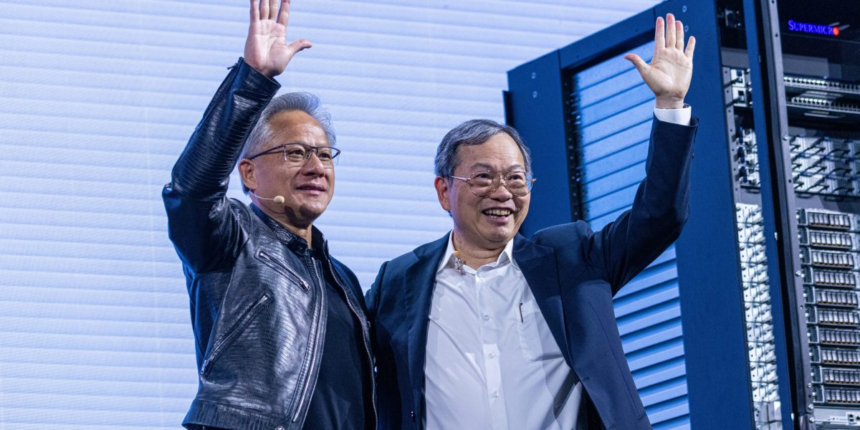
“When we’re together, sometimes we speak Taiwanese, sometimes we speak Mandarin, and then when we disagree, we speak English,” Huang joked in English.
Huang was there to give a keynote address alongside Liang, and the two marveled at stacked server racks as they slipped out in and out of English to joke and compliment each other on their respective tech.
“Very beautiful,” said Huang, as he gazed at a server. “Charles said that everything in here is Nvidia, for all the American citizens.”
At the time, their companies—located in San Jose and Santa Clara about a 15-minute-drive from each other in Silicon Valley—seemed in sync, and the two appeared jovial as they riffed in front of a packed crowd. But a high-profile scandal involving Supermicro has thrown a wrench into the tight relationship between the two companies, threatening a decades-long partnership that has made billions for each organization and helped power the AI boom.
While Liang seeks to distance the company from the tainted elements, Supermicro’s longer-term fate may hinge on whether Nvidia stays close or decides to keep its distance. Nvidia is more than just a longtime partner to Supermicro, it’s an essential part of its business. Supermicro makes about 71% of its revenue from products mostly built around Nvidia’s GPUs—the powerful chips used for training and running AI models. But despite this reliance, Supermicro has no long-term supply contract with Nvidia.
Liaw’s arrest raises “serious credibility issues” for Supermicro, analysts at Bernstein recently wrote in a note to investors. If Nvidia opts to distance itself from Supermicro, the loss of GPUs could have a “devastating impact” on Supermicro’s businesses.
A note written by senior tech analyst Mehdi Hosseini from trading and investment firm Susquehanna called for the ouster of Liang and the entire Supermicro board. Liang has been CEO for nearly 32 years.
“In our view, this indictment only underscores the urgency of replacing the current Chairman/CEO with an external candidate and refreshing the entire board with fully independent directors,” Susquehanna’s note states.
Nvidia and Supermicro were both founded in Silicon Valley in 1993, with each occupying different niches in the burgeoning tech industry. While Nvidia makes the specialized processors used, initially, for computer graphics and now for AI, Supermicro builds server racks and cooling systems that incorporate the chips. It’s one of many companies, including Dell and HPE, that build such systems and compete fiercely.
“Supermicro has a proven track record of time-to-market execution—no one moves faster than Supermicro, and Nvidia loves speed,” said Connors, speaking from a stage decorated with stacked cubes emblazoned separately with the companies’ logos.
Connors said the trend would continue with next-generation systems that would include Nvidia’s Grace and Hopper models.
“We’ve had a great journey together, but the journey’s just begun,” said Connors. And in the years since, Supermicro has become more dependent on Nvidia, which dominates the market for the GPU chips that are critical for AI.
Today, Supermicro counts on its access to Nvidia’s ultra-hot GPUs for the lion’s share of its billions in revenues. Between fiscal 2023 and fiscal 2025, Supermicro’s sales tripled from $7.1 billion to $22 billion following the explosive introduction of ChatGPT to the general public. The stock subsequently crossed $1,000 a share in March 2024, and its market cap hit $67 billion. That hockey-stick growth led to Supermicro joining the S&P 500 in 2024? and making a buzzy debut on the Fortune 500 that same year.
One single chip supplier—known to be Nvidia, although it is unnamed in Supermicro’s filings—accounted for 30.7% of what Supermicro spent on components for customers’ orders in fiscal 2023. That figure ballooned to 64.4% by fiscal 2025. Supermicro doesn’t disclose the names of its suppliers, but analysts consider Nvidia to be the supplier and refer to the company in questions to Liang and chief financial officer David Weigand.
During an earnings call in November 2024, Liang said the company had recently reached the milestone accomplishment of deploying “the world’s largest DLC AI supercluster with 100,000 Nvidia GPUs.” That 100,000 figure means about $3 billion in GPU purchases from Supermicro to Nvidia in a single quarter—no other supplier could come close to reaching the purchase orders Supermicro was directing to Nvidia on behalf of its customers.
Supermicro confirms in its most recent annual report it “does not have long-term supply contracts for all critical materials and core components, but instead often purchases these materials and components on a purchase-order basis.” Supermicro gets purchase orders from customers and then relies on Nvidia to choose it for chip allocations, and Nvidia can walk away whenever it wants.
So far, there’s been no public indication that Nvidia is changing its business relationship with Supermicro, and Nvidia would not comment when asked whether it is reevaluating the relationship.
An Nvidia spokesperson told Fortune the firm’s “ecosystem partners must be committed to strict compliance at every level,” adding that its diligence has led to prosecutions of would-be smugglers and that it will continue to work with the government.
Given how vital the relationship is to Supermicro, though, investors are paying close attention for any signs of change. Days before Liaw’s arrest, for example, Huang got onstage at Nvidia’s GTC conference and praised Supermicro’s competitor.
Nvidia doesn’t break out customers specifically in its disclosures, but Supermicro is estimated to have accounted for between $12 billion to $13 billion of Nvidia’s $130 billion in revenue last year. However, Supermicro punches above its weight in speed to market, and a fracture in the partnership could temporarily hamper Nvidia’s ability to hit aggressive hyperscaler timelines. At the same time, Dell, HPE, and Lenovo all have co-engineering relationships with Nvidia that could fill the gap.
Sachin Ohal, a veteran chief technology officer at International Systems Technologies, said the reputational issue for Nvidia is wholly separate from the operational tie-up between two companies. Customers will keep buying Nvidia’s chips regardless of what a Supermicro cofounder is alleged to have done, he said. And for Supermicro’s customers, changing vendors is a completely different calculus that has nothing to do with a brewing smuggling scandal.
Any customer that wants to exit Supermicro would need to wait three to six months for a transition period, which would include a board-level sourcing and vendor management review, data center chipset review for cyber, data and operations risk review, brand insurance analysis, and a formal account management process, he explained. Funding would need to be allocated for the transition, and a replacement vendor qualified. None of this is free, noted Ohal.
Even more critically, customers have already paid deposits against future Supermicro orders and those deposits have likely already moved from customer accounts to Supermicro and from there onto chip manufacturers like Nvidia, Dell, intel and Micron. Because customers are so sticky with Supermicro, there’s less urgency for Nvidia to act quickly to sever the partnership due to reputational risk or optics.
“The business reality is that it is not easy to decouple or just leave,” said Ohal. “In the tech world, marriage and divorce both cost.”
Supermicro’s stock plummeted 33% in a single day on news of the indictment, although it has regained about 13% since the company announced Liaw’s resignation from the board.
According to the March indictment, Liaw and two others worked to make it seem as though server purchases were going from being assembled in the U.S., shipped to Supermicro’s Taiwan facilities, and then routed to an unnamed Southeast Asian company that was purportedly the final customer. In reality, the indictment states, the tech went from the Southeast Asian company onto Chinese buyers. To hide what they were doing, the accused put thousands of fake servers in warehouses to twice fool auditors, and used hair dryers to remove sticky labels from packages.
The indictment claims the front company behind the purchases grew to become Supermicro’s 11th most-profitable customer worldwide, generating $99.7 million in revenue during a single quarter for Supermicro in fiscal 2024, ranking it alongside major U.S. tech and social media companies.
Supermicro has said it is cooperating with authorities.
“We have taken action against all identified employees and those parties no longer have any relationship with Supermicro,” Liang wrote in his letter. The company said Liaw had resigned from his role on the Supermicro board and declined further comment.
“While it is acknowledged that current executives and directors have not been convicted of any crimes as of this writing, the board’s failure to improve [Supermicro’s] governance and oversight structure and practices, in the context of multiple serious allegations of accounting and compliance irregularities, is considered a material governance failure,” the report states.
Bernstein analysts questioned the move to bring Liaw back into the fold.
“It’s one thing being duped once by rogue employees (allegedly) committing crime right under your nose, but it’s quite another hiring the same person back (as a board director too) and later for that same person to (allegedly) do something worse like this,” the note states.
In addition, Liaw holds 2.5% of Supermicro, a stake valued at about $327 million given the current stock price. He is the second-largest individual shareholder behind Liang and Liu, who together hold 11.4% of the company the three co-founded.
Liaw is also deeply entwined with two other companies that are pivotal to Supermicro’s operations. An unnamed sibling of Liaw’s owns approximately 11.7% of Ablecom, which is a related company run by one of Liang’s brothers that provides the physical structure that provides the racking and stacking aspect of the servers. Liaw’s sibling also holds 8.7% of another related company run by another of Liang’s brothers, Compuware, which provides specialized power distribution needs to Supermicro’s customers.
Ohal said the relationships Supermicro has under its umbrella of related companies—led by Liang’s own brothers—gives it a leg up over other companies.
“If the SEC releases a rule and a financial firm has to upgrade something, Supermicro can do it the next morning because they are already following this news,” said Ohal. “Their back office is already preparing and designing the chassis, power distribution, and their smart solution architects are already designing what the changes are in the system.”
Supermicro’s established alliance with the biggest brand means when products are in the last stage of R&D and testing, Supermicro is embedded enough that it can create data center infrastructure such as chassis and other power distribution components that allow Nvidia to focus on software and chips, said Ohal.
“If tomorrow morning Nvidia launched something, and one of the most important things in all the electronic devices is appropriate power consumption and power distribution within a data center, guess what?” said Ohal. “Supermicro has the biggest advantage because their family company is basically filling all those specialized needs.”
Charles Liang and Sara Liu own approximately 10.5% of Ablecom’s stock, while Charles’ brother Bill Liang owns 16% of Compuware along with his family, where Bill serves as CEO. Ablecom itself holds 15% of Compuware. In the past three fiscal years, Supermicro purchased $811.3 million in products and services from Ablecom, and $833.5 million products from Compuware. The three year combined total is $1.6 billion. Both companies’ sales to Supermicro make up a majority of each company’s total net sales, according to Supermicro, making Supermicro their primary source of revenue.
Greg Thomas, CEO of demand chain intelligence provider ChainSentry, said the relationship between Nvidia and Supermicro created a structural incentive problem, raising the risk that compliance scrutiny would be less rigorous than it needs to be.
“Nvidia really needs Supermicro to be able to bring their chips to market at the scale and speed at which Supermicro’s been doing it, and Supermicro needs the Nvidia chip allocations really to survive,” said Thomas. “This is a kind of mutual dependency and there is a risk that compliance scrutiny becomes less independent and less rigorous than it needs to be.”