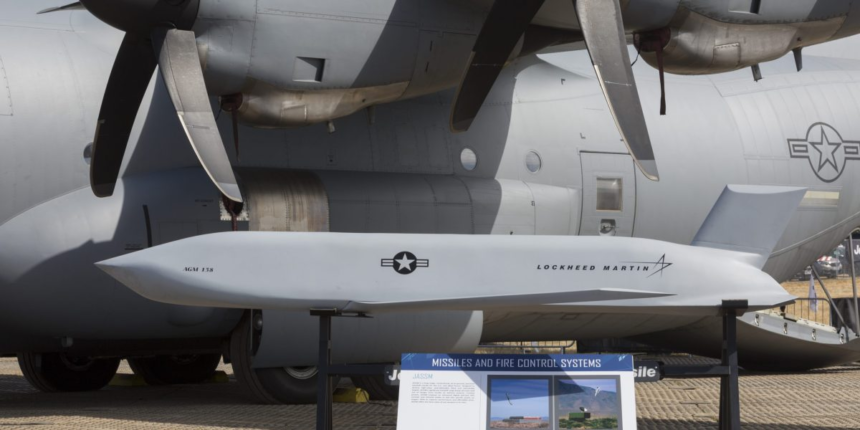
The next steps in the US military campaign against Iran will commit nearly its entire inventory of stealthy JASSM-ER cruise missiles, drawing them from stockpiles devoted to other regions.
The order to pull the $1.5 million weapon from Pacific stockpiles was issued at the end of March, according to a person with direct knowledge of the matter. Missiles at US facilities elsewhere, including the continental US, will be moved to US Central Command bases or Fairford in the UK, said the person, who was granted anonymity to discuss sensitive details.
After the moves, only about 425 JASSM-ER out of a prewar inventory of 2,300 will remain available for the rest of the globe. That would be roughly enough for 17 B-1B bombers on a single mission. Another 75 or so are “unserviceable” because of damage or technical faults.
The JASSM-ER, or Joint Air-to-Surface Missile-Extended Range, can fly more than 600 miles and was designed to hit targets at a safer distances to avoid an enemy’s air defenses.
Along with the shorter-range JASSM — which has a range of about 250 miles, about two-thirds of US stockpiles have been committed to the Iran war, the person said.
The US has been using large numbers of long-range weapons like JASSM-ER for strikes, limiting the risk to service members but reducing stocks of systems meant for more capable adversaries such as China.
US operations through the first four weeks of the war consumed more than 1,000 JASSM-ERs, the person said, speaking on condition of anonymity because of the sensitivity of the matter. US aircraft also fired 47 during the raid to capture Venezuelan President Nicolas Maduro, the person said.
The US has allocated funds to buy more than 6,200 JASSMs since 2009, and production of the baseline JASSM for US supplies ended about 10 years ago.
Committing so many JASSM-ERs to the Iran war does not mean they will all be used. So far they have been launched from B-52 and B-1B bombers, as well as strike fighters.
US Central Command and the Department of Defense did not immediately respond to requests for comment.
On Tuesday, Chairman of the Joint Chiefs General Dan Caine said the US had begun to fly B-52s over Iran, implying that airspace was now safer for attacks using cheaper and more plentiful JDAM precision bombs.
The fact that the older, slower B-52s were only now flying over Iran “raises questions about the degree to which the US has continued to rely on standoff capabilities,” said Kelly Grieco, a senior fellow at the Stimson Center.