The U.S.-Israeli campaign in Iran has been criticized as a war of choice, one with an unclear strategy and even more uncertain target outcomes. But for one of Wall Street’s leading financial chiefs, the choice to wage war in the Middle East may actually have been an unavoidable one.
Now in its second month, the war has exposed the extent to which global energy and financial markets rely on stability in the Middle East. Shortly after the incursion began, Iran’s Revolutionary Guard began warning ships to steer clear of the Strait of Hormuz, the narrow waterway that once allowed one fifth of globally traded oil and natural gas supplies to leave the Persian Gulf. The strait has been under an effective blockade ever since, sending oil prices surging and leaving markets jittery.
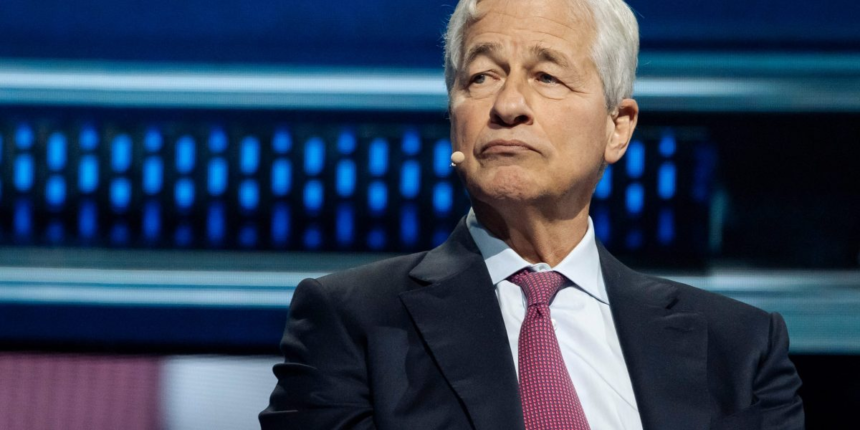
“Having those folks, their throat on the Strait of Hormuz, and funding all these proxy wars. Why the Western world put up with all these proxy wars for 45 years is kind of beyond me,” Dimon said.
The Iranian regime has existed since a revolutionary upheaval in 1979 that replaced the U.S.-backed monarchy with a theocratic Islamic republic that currently rules the country. Post-revolution Iran has consistently been an adversary to the U.S. and Israel. The country has habitually funded and supplied weapons to various proxy militias across the Middle East, such as the Houthis in Yemen, who in recent years have regularly disrupted trade and shipping in the Red Sea and around the Horn of Africa.
Dimon pushed back against that narrative somewhat. When interviewer Jim VandeHei, Axios’s cofounder and CEO, framed the military campaign as a “war of choice,” Dimon asked to “step back on that a little bit.” He said the dovish position that Iran posed “no imminent threat” to U.S. national security is really saying, “The bad thing hasn’t happened [yet].
“They’ve been killing people around the world for 45-plus years. They’ve killed a lot of Americans; they’ve funded not just Hamas—Hezbollah, the Houthis. They have terrorist cells here,” Dimon said.
In Dimon’s telling, the Iranian threat was real and escalating, and he argued that neutering that risk would likely turn the campaign into a success story to balance out the disruption caused so far.
“I literally hope it turns out well and that somehow we get peace in the Middle East permanently,” Dimon said.
Despite the challenging odds, Dimon laid out a narrow path toward stability. He noted that the weakening of Iran and its proxy actors might lower hostilities for a time. It also helps that multiple stakeholders in the region—Saudi Arabia and the United Arab Emirates as well as the U.S. and Israel—are all more or less aligned in their goals, leading to a “higher chance with long-term peace,” Dimon said.
The longer-term strategic payoff of a more stable Middle East would likely justify the volatility incurred since the war began, according to Dimon. But over the past month, the Trump administration has taken its crash course in learning just how elusive a foreign policy goal that might be.