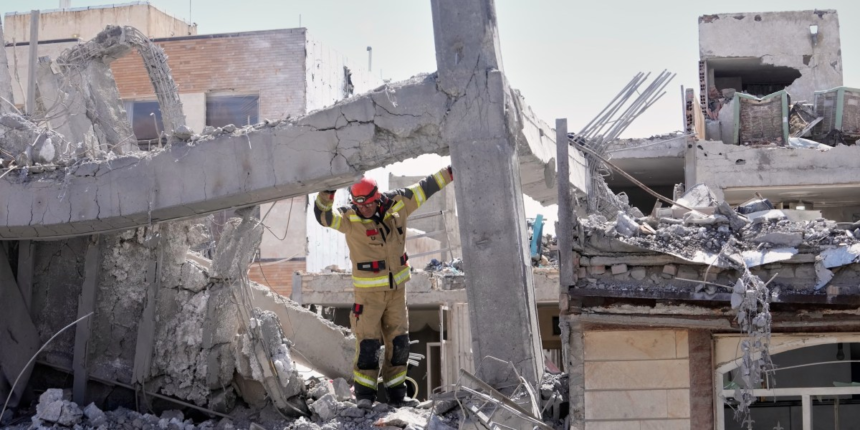
Iran’s nuclear facilities came under attack Friday, state media reported, just hours after Israel threatened to “escalate and expand” its campaign against Tehran. Israel claimed responsibility for the attacks and Iran quickly threatened to retaliate.
Yellowcake is a concentrated form of uranium after impurities are removed from the raw ore. Heavy water is used as a moderator in nuclear reactors.
The Israeli military later hailed its attacks on several Iranian targets including “missile production capabilities, infrastructure remaining from its nuclear program, and terror regime targets.” It said raw materials are processed for enrichment at the Yazd plant and that the strike was a major blow to Iran’s nuclear program.
“You tested us once before; the world has once again seen that you yourselves started playing with fire and attacking infrastructure,” he said. “This time, the equation will no longer be ‘an eye for an eye,’ just wait.”
Trump has said if Iran doesn’t reopen the strait to all traffic by April 6, he will order the destruction of Iran’s energy plants.
U.S. stocks fell further on Friday, lengthening Wall Street’s longest losing streak in nearly four years, and oil prices rose again. The price for a barrel of Brent crude rose 2.9% to $104.81, up from roughly $70 before the war began Feb. 28. Benchmark U.S. crude rose 4.4% to $98.61 per barrel.
Air raid sirens sounded in Israel and the military said it has been intercepting Iranian missiles on a daily basis. Defense Minister Israel Katz said Iran “will pay heavy, increasing prices for this war crime.”
“Despite the warnings, the firing continues,” Katz said. “And therefore attacks in Iran will escalate and expand to additional targets and areas that assist the regime in building and operating weapons against Israeli citizens.”
Israel’s military said its attacks Friday targeted sites “in the heart of Tehran” where ballistic missiles and other weapons are produced. It said it also hit missile launchers and storage sites in Western Iran.
Smoke rose over Beirut after a pre-dawn strike, and Lebanon’s Health Ministry later reported two people were killed.
Saudi Arabia’s Defense Ministry meanwhile said it shot down missiles and drones targeting the capital, Riyadh.
Kuwait said its Shuwaikh Port in Kuwait City and the Mubarak Al Kabeer Port to the north, which is under construction as part of China’s “Belt and Road” initiative, sustained “material damage” in attacks. It appeared to be one of the first times a Chinese-affiliated project in the Gulf Arab states has come under assault in the war. China has continued to purchase Iranian crude.
Diplomats from several countries including Pakistan and Turkey have tried to organize a direct meeting between U.S. and Iranian envoys. Separately, G7 foreign ministers meeting in France adopted a declaration calling for an immediate halt to attacks against populations and infrastructure.
Nevertheless, Secretary of State Marco Rubio said during the G7 meeting that most U.S. objectives in Iran are “ahead of schedule,” and that “We can achieve them without any ground troops.”
Israel deployed the 162nd Division into southern Lebanon to support efforts to protect its northern border towns from Hezbollah attacks and uproot the militant group, the military said.
The U.N.’s International Organization for Migration said Friday that 82,000 civilian buildings in Iran, including hospitals and the homes of 180,000 people, are damaged.
“If this war continues, we risk a far wider humanitarian disaster,” Jan Egeland, secretary general of the Norwegian Refugee Council, said in a statement. “Millions could be forced to flee across borders, placing immense pressure on an already overstretched region.”
Eighteen people have died in Israel, while four Israeli soldiers have been killed in Lebanon. Two Israeli soldiers were severely injured in Lebanon on Friday during an “operational accident,” the military said.
Authorities said more than 1,100 people have died in Lebanon and over 1,900 people have been killed in Iran.
At least 13 American troops have been killed and four people in the occupied West Bank and 20 in Gulf Arab states have also died.
In Iraq, where Iranian-supported militia groups have entered the conflict, 80 members of the security forces have died.
Rising reported from Bangkok. Associated Press writers Giovanna Dell’Orto in Miami; Fay Abuelgasim in Cairo; Sam Mednick in Tel Aviv, Israel; Sam McNeil in Brussels; and Edith M. Lederer at the United Nations contributed.