Indeed, U.S. debt didn’t reach the $1 trillion mark until the early 1980s, hitting $1.1 trillion under President Ronald Reagan.
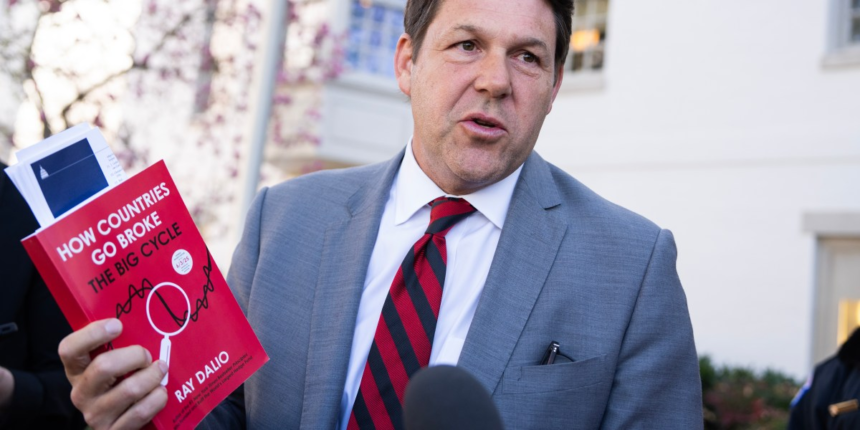
As Arrington points out: “It took roughly 200 years to accumulate the first $1 trillion. Now we add that in a matter of months. Every child in America today carries a $530,000 share of this debt—a crushing legacy we must reverse. Compounding the problem, we now spend more than $1 trillion a year just on interest to service our debt—more than the entire defense budget and triple the amount when Biden took office.”
Arrington isn’t alone in his concern over the nation’s financial trajectory. Figures on the private side of the economy like Jamie Dimon and Ray Dalio have warned of a reckoning caused by debt, and U.S. Federal Reserve Chairman Jerome Powell has also expressed the need for an “adult conversation” about the issue.
“I’m calling on Congress to convene an Article V Convention. It’s time to restore sanity in our nation’s capital and reverse the curse looming large over this country.”
An Article Five Convention allows amendments to the Constitution, for example, targeting borrowing and government spending. If two-thirds of state legislatures apply, then Congress must call a convention, with a further three-quarters of states required to back the amendment for it to become a legal requirement.
In recent memory, presidents have attempted to rectify the U.S. fiscal position. President Obama oversaw the creation of the bipartisan National Commission on Fiscal Responsibility and Reform, commonly known as the Simpson-Bowles (or Bowles-Simpson) Commission. The ensuing report made several recommendations: cutting discretionary spending, reforming tax law, and reshaping health care spending.
“A million cards would be worth $5 trillion, and if you sell 10 million of the cards that’s a total of $50 trillion. Well, we have $35 trillion in debt, so that would be nice,” Trump said last year.
Likewise, tariffs were introduced as a way to offset some of the revenue loss from the likes of the One Big Beautiful Bill Act. Indeed, while Trump’s tariff plans have proved unpopular with foreign governments, economists nonetheless welcome the “peculiar” methods to increase America’s income. As Wharton professor Joao Gomes previously told Fortune: “You can also not deny that [Trump and his administration] bring strange forms of revenue that do change the debt picture.”