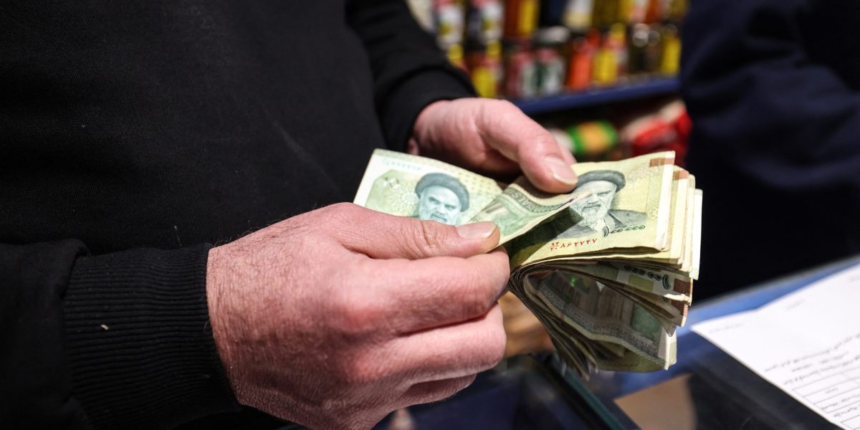
Iran’s economy was already crashing before the U.S. and Israel launched a war against the Islamic republic three weeks ago, and the relentless bombing since then has wreaked even more havoc.
Inflation has worsened and apparently is so bad now the government issued its largest-ever currency denomination: the 10 million rial note (equivalent to about $7).
As prices continue to spiral higher while the war boosts demand for cash, long lines formed to withdraw the fresh banknotes, and supplies quickly ran out.
Iran’s central bank said electronic payments are still the main methods for transactions, though the 10 million rial bill will “ensure public access to cash,” the FT reported.
But doubts about the viability of electronic payments have grown during the war as the U.S. and Israel target the regime’s levers of control.
In addition to bombing Islamic Revolutionary Guard Corps and Basij paramilitary forces, a data center for Bank Sepah was also hit on March 11. Sepah is the country’s largest bank and is responsible for paying salaries to the military and IRGC.
Meanwhile, a currency collapse that began after last year’s U.S.-Israeli bombardment has fueled crippling inflation. The rial lost 60% of its value in the months after the 12-day war, and food inflation soared to 64% by October. It accelerated further to 105% by February, vaulting overall inflation to 47.5%.
The exchange rate fell as low as 1.66 million rials per $1 last month, though it strengthened to about 1.5 million rials as the U.S. temporarily lifted sanctions on Iranian oil.
Heightened demand for cash further stresses a financial system that was considered dubious even before the current war started three weeks ago.
The failure of Ayandeh Bank late last year forced the regime to fold it into a state-run lender, underscoring how fragile the sector was as bad loans piled up to politically connected cronies.
During his captivity, he learned from imprisoned former officials and business elites that politically connected borrowers bribed assessors to inflate the value of properties, which were used to obtain massive loans.
Instead of repaying the loans, borrowers just gave their properties to the bank, which sold them to other banks at a paper profit, according to Namazi. Those banks knew the properties were overvalued “garbage,” but played along in the scheme by dumping their own toxic assets in exchange and booking fictitious gains.
“The result is a closed-loop Ponzi scheme, sustained by mutual deception and regulatory complicity,” he added. “This practice has metastasized over the past 15 years and is far more extensive than this simplified description suggests. And this is only the banking system. Much of the rest of Iran’s economy is afflicted by similarly entrenched corruption and mismanagement.”