It was the first time Israel’s nuclear research center has been targeted in the fighting. Israel’s military said it was not able to intercept missiles that hit the southern cities of Dimona and Arad, the largest near the center in Israel’s sparsely populated Negev desert.
“This is a very difficult evening,” Prime Minister Benjamin Netanyahu said, adding that more emergency resources were being sent to the scene.
“The war is not close to ending,” Israel’s army chief, Gen. Eyal Zamir, said earlier in the day.
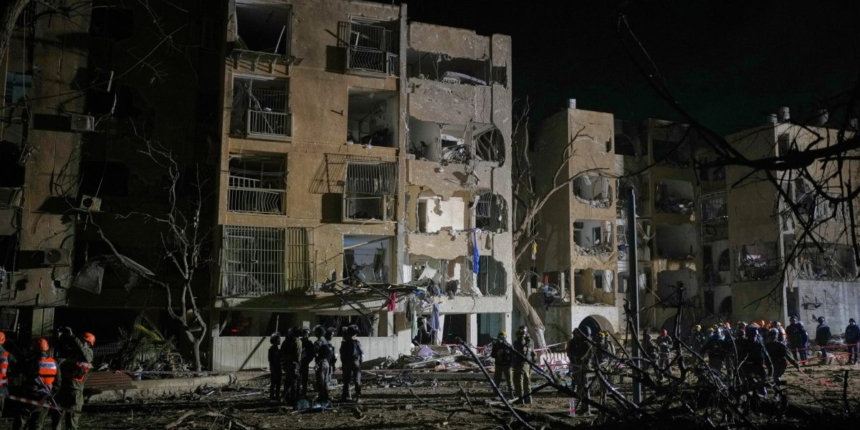
Footage from Israel’s emergency service showed a large crater next to what appeared to be apartment buildings with outer walls sheared away. The missile appeared to have struck an open area.
Rescue workers said the direct hit in Arad caused widespread damage across at least 10 apartment buildings, three of them badly damaged and in danger of collapsing. At least 64 people were taken to hospitals.
Dimona is about 20 kilometers (12 miles) west of the nuclear research center and Arad around 35 kilometers (21 miles) north.
“If the Israeli regime is unable to intercept missiles in the heavily protected Dimona area, it is, operationally, a sign of entering a new phase of the battle,” Iran’s Parliament Speaker Mohammad Bagher Ghalibaf said on X before word of the Arad strike spread.
The International Atomic Energy Agency has said the bulk of Iran’s estimated 970 pounds (440 kilograms) of enriched uranium is elsewhere, beneath the rubble at its Isfahan facility. It said on X it was looking into the strike.
Iran retaliated hours later.
U.K. officials did not give details of the strike that targeted the Diego Garcia base Friday, which was unsuccessful. Britain’s Ministry of Defense described Iran as “lashing out across the region.”
It’s unclear how close the missiles came to the island. Iran previously asserted that it has limited its missile range to below 2,000 kilometers (over 1,200 miles).
But military experts said Iran may have used its space launch vehicle for an improvised firing. “If you’ve got a space program, you’ve got a ballistic missile program,” said Steve Prest, a retired Royal Navy commodore.
Britain has not participated in U.S.-Israeli attacks but has allowed U.S. bombers to use its bases to attack Iran’s missile sites. On Friday, the U.K. government said bombers could use Diego Garcia to attack sites used to target ships in the Strait of Hormuz.
As Iran threatens shipping on the Strait of Hormuz, the United Arab Emirates joined 21 other countries including the U.K., Germany, France and Japan in expressing “readiness to contribute to appropriate efforts to ensure safe passage.”
The head of U.S. Central Command, Adm. Brad Cooper, asserted that Iran’s ability to attack vessels on the strait had been “degraded.” He said 5,000-pound (2,270-kilogram) bombs were dropped earlier in the week on an underground facility along Iran’s coast used to store anti-ship cruise missiles and mobile missile launchers.
The U.S. is deploying three more amphibious assault ships and roughly 2,500 additional Marines to the Middle East, an official told The Associated Press. Two other U.S. officials confirmed that ships were deploying, without saying where they were headed. All three spoke on condition of anonymity to discuss the operations.
Gulf countries reported more attacks. A missile alert sounded Saturday night in Dubai. Saudi Arabia said it downed 20 drones in its east, home to major oil installations.
Iran’s death toll in the war has surpassed 1,500, the state broadcaster reported, citing the health ministry. In Israel, 15 people have been killed by Iranian missiles and four others have died in the occupied West Bank. At least 13 U.S. military members have been killed, along with well over a dozen civilians in Gulf nations.
Israel’s military said it was conducting a “targeted ground operation” in southern Lebanon and at least four militants were killed. Hezbollah said its fighters clashed with troops in the southern village of Khiam.