“It’s a crazy situation,” said Eric Napoli, Chief Legal Officer at AirHelp, the world’s largest flight compensation platform. “Different situations in different places in the world are all convening at once.”
Napoli said that more travelers have been turning to AirHelp in recent months to recover money lost due to flight disruptions. Again, the combination of a war grounding flights and driving up fuel costs, coupled with ongoing conflicts in Mexico, government workers calling out sick after a month and counting of working without pay, and poor weather conditions, has led to a perfect storm that hasn’t been seen since COVID-19 saw the world come to a standstill. Above all, Napoli said, we’re all asking the same question we asked back then: when is it going to end?
“The sensation of the pandemic is similar in the sense that we’re like, okay, we don’t know what just happened,” Napoli told Fortune. “What’s the future going to be? Is this something that’s going to last two weeks, three weeks, a year? Is everything going to change? This is what we don’t know.”
The conflict between the U.S., Israel, and Iran has effectively shattered the Gulf’s role as a global aviation crossroads. Airlines have grounded or rerouted flights, leaving passengers who booked connections via Dubai, Abu Dhabi, or Doha in limbo.
“Economies like Qatar or the Emirates that have really based themselves on being the connecting hub between Europe, the US, and Asia. All that stuff has been frozen,” Napoli said. “Anybody traveling to Asia from the U.S. or Europe suddenly sees major flight disruption. That’s been incredibly frustrating for passengers.”
For those stranded in the Gulf, options are grim. Napoli described scenes of travelers scrambling for alternatives, such as driving for hours to reach operational airports in neighboring countries. “People are all on wait lists for flights, and it’s very touch-and-go,” he said. “From one day to the next, airspace might close.”
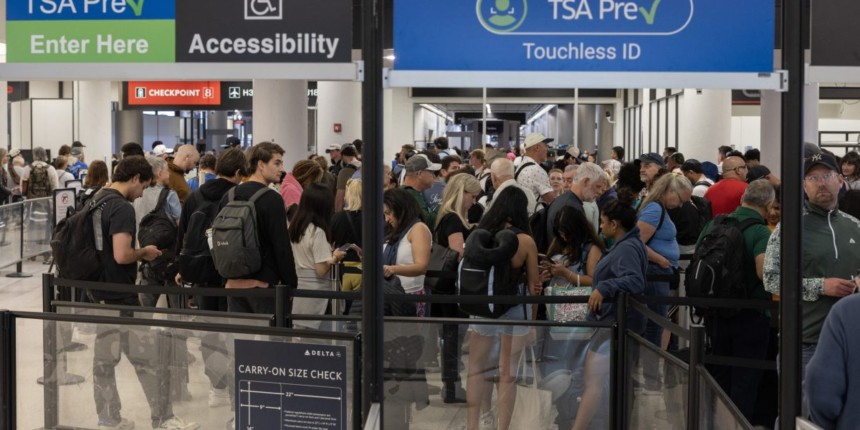
“We’ve had TSA issues: really long lines just to go through security, really long lines at border control,” Napoli said. “All of that has just made travel super frustrating for Americans.”
Data from AirHelp highlights the scope of the disruption. In February 2026, the worst-performing major airports recorded staggering flight disruption rates: Fort Lauderdale-Hollywood International led the country at 61.8% of flights disrupted, followed by Newark Liberty at 61.0% and O’Hare at 59.1%. New York’s LaGuardia and Ronald Reagan National rounded out the bottom five at 58.7% and 58.2%, respectively. Even the best-performing airports were far from smooth: Salt Lake City International topped that list at a 39.6% disruption rate.
“Uncertainty is always bad for consumer confidence, and it’s bad for passenger confidence,” Napoli said. “We want people to come to the U.S. for the World Cup. If there’s a fear of really long passport control difficulties, if there are fears of lots of delays and nothing people can do about it, if ticket prices become incredibly expensive, then we won’t see those numbers.”
The consequences extend well beyond the airport. “It won’t just be bad for the event,” Napoli added. “It will be bad for all the businesses that have planned their budgets around it. Hotel occupancy, restaurants: a lot of businesses are really depending on a successful World Cup.”
For now, Napoli says it’s still too early to measure the full fallout of what he calls an “incredibly uncomfortable” moment for the airline industry. Claims, he notes, come in months after disruptions occur, not days. In the meantime, he has his own verdict on how bad things really are. “These things always happen when I’m about to travel,” he said with a laugh. He’s still booking his family vacation anyway.