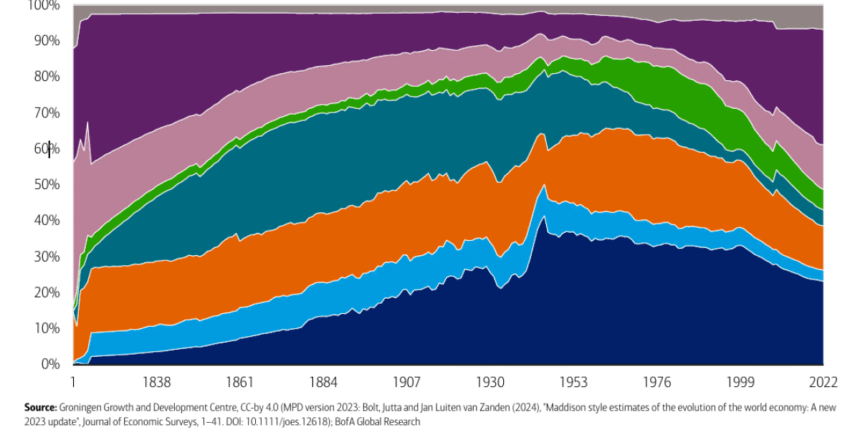
For roughly 1,800 years, the world’s largest economy sat somewhere along the Yangtze River. A new chart from the Bank of America Institute — spanning 2,000 years of global GDP data — shows that America’s moment at the top wasn’t destiny. It was an accident of history. And it’s ending.
The U.S. spent the better part of the 20th century treating its position at the top of the economic order as something close to a birthright. “American exceptionalism,” the idea that the country was fundamentally distinct from — and often superior to — other nations due to its unique founding principles, political institutions, historical development, and perceived moral mission in the world, dates back to the precolonial days and John Winthrop’s 1630 articulation of the country as a “city upon a hill.”
The chart also shows, however, that there’s always been one other exceptional country. The chart plots the share of global GDP held by the world’s major powers from the year 1 AD through 2022. What it shows is both humbling and, for anyone paying attention to the current global moment, entirely unsurprising: the world’s economic center of gravity is shifting back toward where it spent most of recorded history. Back toward Asia. Back toward China.
The chart’s most striking feature is not a line going up. It’s a line going down — and then, slowly, back up again.
Beckert’s book highlights how ancient mercantile communities of capitalists emerged in the Middle East and Asia, for instance, with the Port of Aden, in Yemen, or Cambay, in modern Gujarat, India. Goods left Aden and traded across oceans as early as 1150, and Song-dynasty China invented paper money hundreds of years before Europe did.
The Groningen data show clearly that Europe’s rise — led by the UK, Germany, Italy, France, and Spain — was a 19th-century phenomenon. The United States didn’t register meaningfully on the chart until the late 1800s, and didn’t achieve its peak dominance until the mid-20th century.
That peak, visible as a bulging arc of American blue across the chart, coincided with a historically anomalous moment: a Europe devastated by two world wars, a China wracked by civil war and Maoist catastrophe, and an India still emerging from colonialism. In other words, the era of American exceptionalism was also, in large part, the era of everyone else’s misfortune.
“These transitions often followed major geopolitical or financial turning points,” BofA Institute noted in its report — a line that, in retrospect, reads less like historical observation and more like a warning.
What is implied, of course, is that the winners of this current period will determine how the next world order will work and who will benefit.
The BofA Institute’s report frames today’s shifts as part of a familiar pattern: “renewed focus on affordability, rapid advances in AI, and a broader shift from services back toward manufacturing”. Those three forces — cost deflation, AI disruption, and the reindustrialization of the global economy — all tilt, at least at the margin, toward China’s strengths rather than America’s.
What the chart ultimately shows is not that American exceptionalism was a myth. It’s that it was a moment — a historically contingent window, opened by catastrophe elsewhere and now gradually closing as the rest of the world heals, industrializes, and competes. For 2,000 years before the American century, the world’s largest economy sat somewhere along the Yangtze River. The line on the chart that shows China’s share plummeting to near-zero and now racing back upward is not a story about China catching up.
It’s a story about the world returning to normal.