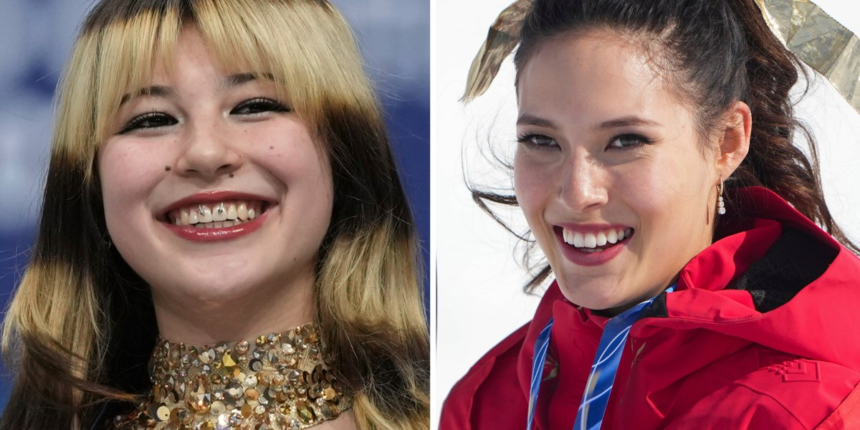
It is as captivating as it is divisive: the tale of two Chinese American athletic geniuses who have so much in common but make such different choices.
But public opinion diverges over their choices about the countries for which they compete.
Gu chooses to represent China, while Liu waves the U.S. flag. Those decisions are generating heated debates over loyalty — an issue interwoven with money, values and politics on both sides of the Pacific Ocean.
“Any American who works with a foreign adversary has not only betrayed our country but must be stripped of all benefits from doing so,” said Rep. Andy Ogles, a Republican from Tennessee.
To a large extent, Gu’s is a story of China’s economic success, when its spectacular growth has made it alluring for those with Chinese roots to return for greater financial gains.
Gu was born in San Francisco to a Chinese mother working in finance. No information about her father is available. Gu competed for China in the Winter Games in both 2022 and 2026, and she has landed endorsements worth millions of dollars from major Chinese brands as well as multinationals eyeing the Chinese market.
In 2022, when she won two golds and one silver in Beijing, Gu was a national idol and fondly known by her Chinese nickname, Frog Princess. Video clips of her eating Chinese snacks went viral on social media. Her performances in Italy were closely followed and celebrated in China.
She has long said her decision to compete for China has more to do with getting girls involved in her sport — with a greater opportunity for growth there than in the United States — than about pure dollars and cents.
But controversy over Gu’s citizenship has cast a shadow over her popularity, with members of the public questioning her loyalty, wondering aloud if she has given up her U.S. passport to comply with the Chinese law against dual citizenship. Gu has dodged the question, making it anyone’s guess.
Hu Xijin, a former party newspaper editor in China, argued that what’s important for China is attracting talents like Gu and chalking it up as a win over the United States.
“Today’s China is stronger, and it can provide Gu with interests that cannot be realized if she represented Team U.S.A.,” Hu wrote in a social media post. “She has the sharp judgment to pick Team China, and this is the magnetic effect resulted from China’s growth.”
For Liu, skating for China is out of the question.
Liu was born to Arthur Liu through surrogacy. Unlike Gu’s mother, Liu’s father fled China when he was wanted by the authorities for his involvement in the 1989 student movement that ended with a bloody crackdown in the heart of Beijing and forced many student activists into exile. Hundreds, perhaps thousands, were killed when the military quelled the protests on June 3-4, 1989.
“Chinese people still have no freedom of speech, no freedom of religion, and there are still political prisoners in China,” Arthur Liu recently told Nikkei Asia. “Clearly, I wouldn’t allow my daughter to compete for such a government.”
This time, she became the first American woman to win Olympic figure skating gold in 24 years. Her story spread wildly in China’s social media, garnering praises such as “free spirit” and “more genuine.” Some, however, pledged loyalty to Gu and suggested that Liu’s success was nothing for the Chinese people to get excited about.
The comparison between his daughter and Gu was so prevalent that Arthur Liu was asked about it.
Asked about the comparison recently, Alysa Liu told Newsweek: “Oh, my God, I think this discourse is really silly because we’re both half Chinese.”
In response, Gu said, “I’m flattered. Thanks, JD! That’s sweet,” USA Today reported.
Ogles’ bill aside, Rep. Lisa McClain, a Michigan Republican, slammed Gu for not even having “the respect for the country which has given them so much to represent that country.”
Citizenship change is nothing new in competitive sports, and other Chinese Americans or Chinese Canadians have played for Team China. But they have not riled up public opinion as Gu has, noted Susan Brownell, a professor at the University of Missouri-St. Louis who studies Chinese sports and the Olympic Games. “It does really appear,” she said, “that part of the issue here is if you’re good enough to beat the U.S.”
Badiucao, a Chinese-Australian artist, illustrated the comparison in two drawings: one of Alysa Liu skating triumphantly along with the Statue of Liberty, the other of Gu draped in an oversized, blood-dripping piece of Chinese currency, its image of Mao Zedong looking over her shoulder.
“In a world of Eileen Gu,” the artist wrote, “be Alysa Liu.”
___
AP sports writer Stephen Wade in Tokyo contributed to this report.