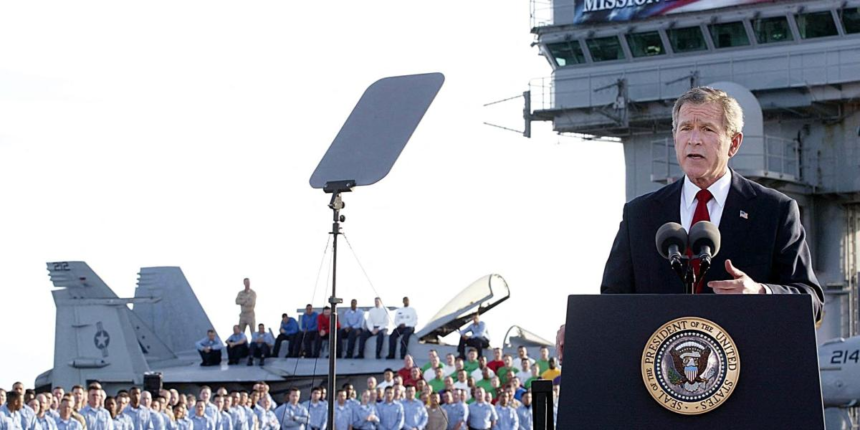
As oil topped $120 a barrel Monday and Iran named a new Supreme Leader, Wall Street is still betting this war will be short—the same bet investors made about Iraq in 2003, when a conflict predicted to cost $60 billion ultimately consumed $3 trillion. Those trillions ultimately showed up as higher deficits, higher borrowing costs, and a decade of elevated geopolitical risk—a path markets never modeled in 2003.
Now, Scott Galloway— an NYU professor, entrepreneur, and co-host of the “Prof G Markets” podcast—is drawing that line explicitly. On Monday’s episode of the podcast, he and co-host Ed Elson argued that investors’ current calm is not savvy risk management. It is, in Galloway’s framing, a failure of institutional imagination—the inability of governments and markets to think beyond the first few weeks of a conflict, from the price of reconstruction to the refugees, the blowback, and the political consequences—that risks being just like the one that preceded the Iraq catastrophe,
The S&P 500 dipped only modestly in the immediate aftermath of U.S. and Israeli strikes that killed Iran’s Supreme Leader, Ayatollah Ali Khamenei, and caused significant damage to government and defense infrastructure. Investors appeared to price in a brief, contained operation. Then Monday arrived.
Galloway’s sharpest critique is not just that this war could be long—it is that no one in Washington appears to have a coherent plan for what comes after the bombs. He called the current operation “war as improv.” The administration bypassed Congress, launching strikes without an Authorization for the Use of Military Force and without briefing the Senate Intelligence Committee. “When you declare war—and this is war—you are supposed to get congressional approval,” Galloway said. He noted that the White House messaging has toggled between calling the operation a “special combat mission” and a “war” aimed at regime change.
The strategic incoherence of the current moment has a direct media precedent. In 2003, the press largely failed to scrutinize the Bush administration’s claims about Iraq’s weapons of mass destruction. A post-mortem by CNN media reporter Howard Kurtz identified at least 140 front-page articles that effectively echoed the administration’s pro-war narrative. Harvard’s Nieman Foundation later concluded that top editors and reporters engaged in a “credulous, stenographic recitation” of official arguments, making the press “de facto accomplices to a war undertaken on false pretenses.”
“The worst geopolitical mistake of this century” is how Galloway described the Iraq invasion. His warning, issued Monday, was straightforward: the current administration’s lack of coherent strategy risks producing a second one—and markets, once again, may be the last to see it coming.