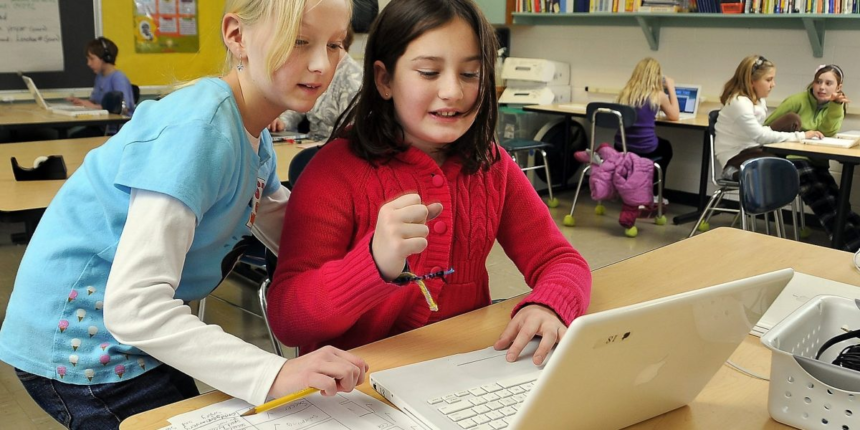
“Before 2014, computers were in schools, they were just peripheral,” Horvath told Fortune. “After 2014, every school had to have digital infrastructure in order to take the state assessment.”
According to Horvath, author of the 2025 book The Digital Delusion: How Classroom Technology Harms Our Kids’ Learning—and How to Help Them Thrive Again, Utah’s test score data isn’t a fluke; it’s part of a global trend of plummeting test scores that have coincided with the rise of easy access to computers and tablets in the classroom.
Technology was put in schools in a bid to help them learn. Instead, Horvath said, computers had an adverse impact on learning.
Horvath blames educational technology (edtech) for these atrophying skill sets, arguing that at the turn of the 21th century and through its first decade and a half, tech companies and advocates pushed a false narrative that the education system was broken, but computers could fix it. Instead, Horvath said, the plan backfired.
The snowballing of edtech in classrooms was associated with an emerging narrative on how tech impacts learning, Horvath said: Education was broken, and computers could provide adaptability to students’ differing learning needs. With knowledge at their fingertips, students could be empowered to learn all by themselves.
“Everything was looking good,” Horvath said. “So by what argument were they saying education was broken? There was no argument. They were just making it up to try and get people fomented to say, ‘I guess we need a new tool in there.’”
A close look at the history of edtech reveals criticisms of the pedagogy that go back nearly 100 years.
“The reason they all quit was the transfer problem,” Horvath said. “They found that kids would be very good so long as they were using the tool, but as soon as they went off the tool, they couldn’t do it anymore.”
The results seem to follow, no matter what decade the technology is found in. Today’s teaching machines have taken the form of AI, and educators are once again concerned the technology will encourage students to master the use of bots at the expense of their own critical thinking and synthesis skills.
“Students can’t reason. They can’t think. They can’t solve problems,” said one teacher interviewed for the study.
Horvath was inclined to agree. He said the best learning happens where there is friction, or when a student needs to grapple with a problem and work through it. AI is most effective when experts use it, he argued. Someone with mastery of a skill knows how to deploy a certain AI tool and then fact-check its output. A student, however, doesn’t have mastery and looks to AI only for shortcuts.
“The tools experts use to make their lives easier are not the tools children should use to learn how to become experts,” Horvath said. “When you use offloading tools that experts use to make their lives easier as a novice, as a student, you don’t learn the skill. You simply learn dependency.”
“If you really want kids to be good at AI, continue to teach them stuff. Teach them math, teach them literacy, teach them numeracy, give them a general education,” Horvath said. “So when they’re older and experts, they can bring meaning to that machine and now use it to make their lives easier, as opposed to trying to help them figure out how the world works.”