Yoshua Bengio, like many participants at India’s AI Impact Summit, was running late.
By 6 p.m., the New Delhi roads were too gridlocked for the deep-learning pioneer, known as one of the “godfathers” of AI, to successfully make it to an event discussing the international AI safety report he’d chaired. Instead, he delivered his address to a group gathered at the Canadian embassy via a blurry video link.
“We were stuck in a roadblock for 45 minutes,” Bengio explained amid apologies, adding that he’d had to reroute to ensure he didn’t miss a dinner with the Indian prime minister. Bengio did, at least, make it to the dinner, unlike Sara Hooker, CEO of Adaption Labs, who wasn’t quite so lucky.
“[I] got stuck in traffic getting back to the venue after I changed into gala attire,” Hooker said in a social media post. “Would have been honored to attend. But after 4 hours in traffic I was equally honored to sit down to really excellent room service at 11 pm.”
The logistical chaos was a fitting background for the week, which was a mix of investment announcements, gridlocked international diplomacy, and people stuck in actual traffic jams. India’s AI Impact Summit was the fourth in a series of global AI summits—following those held at Bletchley Park in the U.K., Seoul, and Paris—and the first to be held in the Global South. More than 20 heads of state, the CEOs of the world’s leading AI companies, and delegates from over 80 countries had gathered in New Delhi with the hope of forging a credible path for middle powers to shape the AI era, and to ensure that the technology’s benefits don’t remain concentrated among a handful of American and Chinese companies.
To its credit, the summit did deliver a diplomatic declaration that got 88 countries and international organizations to commit to inclusive AI development. It also produced a set of voluntary governance commitments for frontier AI companies and announced over $200 billion in investment. The execution, however, at points descended into farce.
From the first day it was clear that the summit’s execution was unlikely to meet its lofty ambitions. New Delhi is infamous for its terrible traffic, but as attendees quickly learned, when various heads of state or important global business leaders need to navigate around the city, the police close the roads completely to help speed VIPs through. This practice, known locally as “VIP movements,” may be fine when just a few VIPs are in town, but it causes hours-long traffic jams when a summit brings dozens and dozens of heads of state and global CEOs to the city at once. The result was that speakers, delegates, and journalists were stranded across the city, often missing meetings and speaking events.
In one amusing moment, guests waiting in the lobby of New Delhi’s Imperial hotel were shuffled into a cramped corridor to make way for an incoming VIP—only for a second security guard to come running over, insisting that two of the men now squeezed into the corridor were his VIPs from America and were needed elsewhere. (These protests fell on deaf ears, and no one moved for at least 10 minutes.)
The closed roads had the worst knock-on effects for the delegates, with some attendees walking miles through New Delhi to get out of the conference, with no taxis available and no shuttle service in place.
The summit’s main venue was also overcrowded and chaotic. People complained of long queues, overcrowded rooms, poor communication infrastructure, and a bizarre and ever-changing entry policy. One attendee said she traveled three hours in traffic only to be left waiting in an entry queue for another two hours. Many complained of a “VIP culture” at the summit that left people feeling like third-class citizens.
Dhananjay Yadav, founder of India-based AI wearables company NeoSapien, had his display tech stolen from the exhibition hall during the chaos. He told Fortune that before leaving, he was assured it was a secure zone, but when a volunteer went to collect the company’s devices after the gates reopened at 6:30 p.m., the tech was gone.
“It was disheartening,” Yadav said. “It’s just disappointing considering the effort I put into the event.” (He later said New Delhi police recovered the devices after reviewing CCTV.)
Another source of eye rolls among attendees was a lack of Wi-Fi and spotty phone service. Bharat Mandapam, the main venue for speakers and panels, apparently has unstable reception at the best of times, let alone when filled with hundreds of delegates. Strangely, the venue also banned items like keys, laptops, cosmetics, and earbuds from entry. These rules were enforced with various levels of stringency throughout the week, but several journalists complained of having to argue with security staff in order to bring in innocuous items such as laptops and cosmetics.
The summit also suffered from scheduling hiccups. Several speakers complained that the times and locations of events had not been communicated with enough warning, and several panels appeared to go ahead with at least one speaker absent.
Gates pulled out just hours before he was due to deliver a keynote, with the Gates Foundation saying in a statement that the decision was made “to ensure the focus remains on the AI summit’s key priorities.” The withdrawal was surprising as the foundation had confirmed just days earlier that Gates was still planning to attend. Rumors about his attendance had been swirling throughout the week owing to renewed scrutiny of his ties to the late financier and convicted sex trafficker Jeffrey Epstein; just weeks earlier, the U.S. Department of Justice had released emails revealing contact between Gates Foundation staff and Epstein, suggesting the two had participated in meetings following Epstein’s release from prison focused on Gates’ charitable ambitions. Gates has maintained that his dealings with Epstein were limited to discussions about his charitable work, and has said meeting with him was an error of judgment.
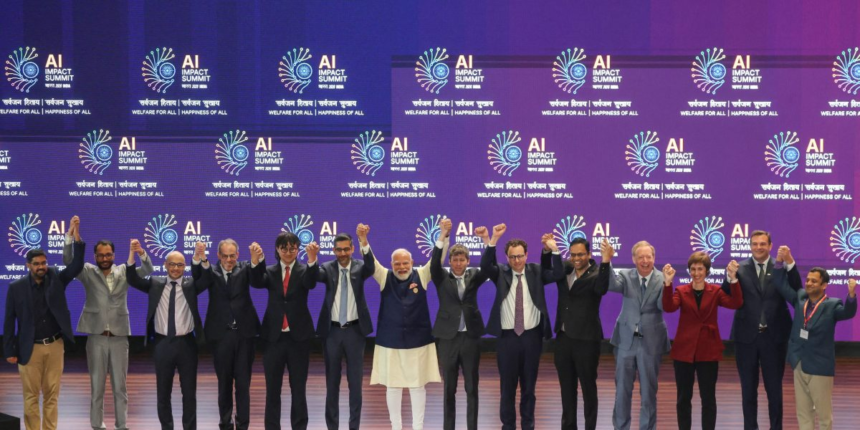
Other awkward—and more viral—moments included OpenAI CEO Sam Altman and Anthropic CEO Dario Amodei stealing the spotlight from Modi by refusing to hold hands for a photo op designed to be a show of unity and triumph. At a summit built around the idea of global cooperation on AI, two of the most powerful men in the industry apparently couldn’t quite bring themselves to touch.