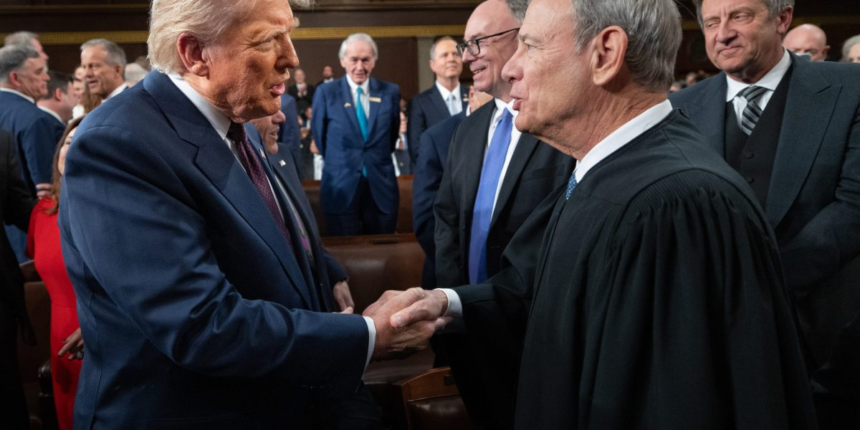
President Donald Trump’s trade war isn’t over, despite the Supreme Court striking down his global tariffs, but the legal setback adds to the growing wall of resistance.
The last two months represent a stunning reversal from the first year of his second term when lawmakers, CEOs, foreign governments, and the high court itself deferred to the president—even as he sought to tear down the existing world order.
He combined his insults with bravado over his ability to enact a fresh set of tariffs under separate laws, and he quickly followed through by imposing a 10% global duty that he hiked to 15% just a day later.
“Still, the importance of this judgment is another step in piercing President Trump’s seeming invincibility,” wrote Kurt Campbell, a longtime diplomat and national security official who is also chairman of the Asia Group.
“We have seen a series of domestic actions, including the withdrawal of Immigrations and Customs Enforcement from Minneapolis, various Republicans separating from the White House on domestic legislation and now the Supreme Court basically hollowing out the most important plank on President Trump’s economic vision.”
In a note on Friday, he also pointed out that Congress had already pushed back on his tariff agenda. In fact, several Republicans joined Democrats in the House of Representatives to revoke Trump’s import taxes on Canada, though the vote earlier this month was largely symbolic.
Campbell predicted that lawmakers on Capitol Hill from both parties will reaffirm the Supreme Court decision, making it difficult for the Trump to pass any legislation meant to reinforce his tariff authority.
“This is significant at a time that the president seeks to head into midterm elections with a head full of steam,” he said.
Trump’s rush to establish alternate tariffs clashes with his attempts to address the affordability crisis, which helped Democrats win off-year elections in 2025 and is shaping up to deliver control of at least one chamber of Congress in 2026.
If Democrats do take over Congress, it will severely limit Trump’s maneuvering room as they seek to rein in his administration’s spending and policies, especially in areas like immigration.
The Supreme Court’s tariff decision could signal that the judicial branch may join the legislative branch in drawing a line against the executive branch.
“It took almost a decade, but Chief Justice John Roberts and the Supreme Court finally found a way to stand up to President Donald Trump’s executive power overreach, striking down the tariffs that are the signature initiative of his presidency,” he wrote on Friday.
At the start of the new year, Trump seemed to be riding high after the U.S. military pulled off a stunning raid that captured Venezuelan dictator Nicolás Maduro, despite grumblings that another foreign intervention strayed from his “America first” motto.
That rallied support for Powell on Capitol Hill, including from key Republicans who want to preserve central bank independence.
And the following week, federal agents shot to death a second U.S. citizen in Minnesota during Trump’s deportation campaign in the state.
Eventually, Trump dispatched his border czar, who ousted the Border Patrol’s Greg Bovino and announced an end to the Minnesota surge.
At the time, the swirl of events added up to a tipping point for Trump.