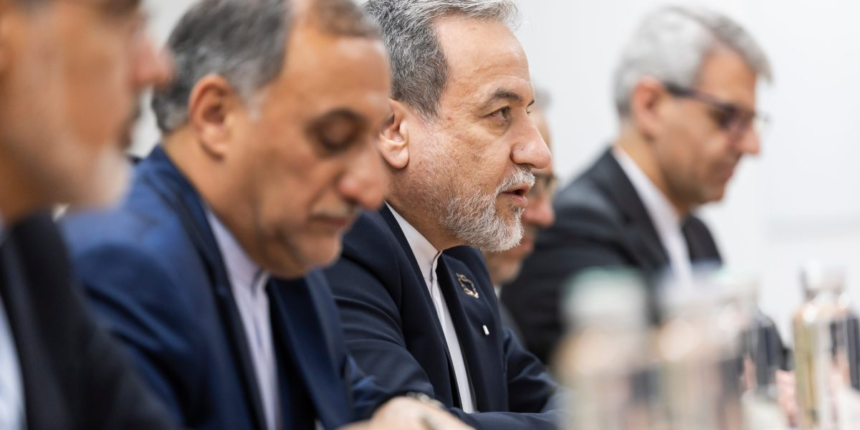
Earlier Friday, Iranian Foreign Minister Abbas Araghchi said in a TV interview that his country was planning to finalize a draft deal in “the next two to three days” to send to Washington.
“I don’t think it takes long, perhaps, in a matter of a week or so, we can start real, serious negotiations on the text and come to a conclusion,” Araghchi said on MSNOW’s “Morning Joe” show.
Both Iran and the U.S. have signaled that they are prepared for war if talks on Tehran’s nuclear program fizzle out. “We are prepared for diplomacy, and we are prepared for negotiation as much as we are prepared for war,” Araghchi said Friday.
Ali Vaez, an Iran expert at the International Crisis Group, said Iran “would treat any kinetic action as an existential threat.”
Vaez said he doesn’t think Iran’s leaders are bluffing when they say they would retaliate, while they likely believe they could maintain their hold on power despite any U.S. airstrikes.
“What we are now talking about is how to make sure that Iran’s nuclear program, including enrichment, is peaceful and will remain peaceful forever,” he said.
In response to Araghchi’s claim, a White House official said Trump has been clear that Iran cannot have nuclear weapons or the capacity to build them and that it cannot enrich uranium. The official wasn’t authorized to comment publicly and spoke on condition of anonymity.
Although Iran insists its nuclear program is peaceful, the U.S. and others suspect it is aimed at eventually developing weapons.
Trump’s comments have faced pushback from some lawmakers who say the president should get Congress’ approval before any strike.
Democratic Sen. Tim Kaine of Virginia said Friday that he has filed a war powers resolution that would require that step. Though it has no chance of becoming law — in part because Trump himself would have to sign it — some bipartisan consensus has arisen recently among senators who forced votes on previous resolutions on military action in Venezuela.
“If some of my colleagues support war, then they should have the guts to vote for the war, and to be held accountable by their constituents, rather than hiding under their desks,” Kaine said in a statement.