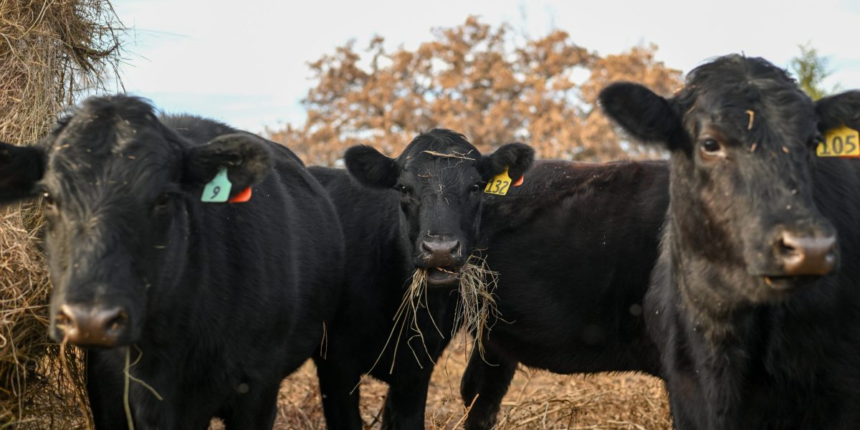
While the cattle industry is cyclical, the current contraction has lasted longer than expected because there’s a lot more money to be made selling animals for slaughter while very young rather than keeping them to expand herds.
At current levels, any expansion in the US herd would at the earliest make it to the retail counter in 2028, keeping beef prices elevated for longer, said Don Close, a senior animal protein analyst at Terrain Ag.
The ongoing cattle shortage has been a boon for ranchers, particularly the so-called cow-calf producers at the start of the supply chain who sell young animals to other ranchers. “In my opinion, you should be profitable right now as a cow-calf operation,” said Brandi Buzzard, a rancher in Kansas.
But even they see their conditions as precarious. Oklahoma-based Kacie Scherler, a fifth-generation rancher, says she’s being squeezed by an inflationary environment, with costs for equipment, repairs and land rent all soaring in tandem.
“It actually feels extremely fragile,” said Scherler, who with her husband Zach Abney runs a 5,000-acre cow-and-calf enterprise. “So even though cattle are worth more than they have ever been, it costs a lot more to stay in business.”
Further down the supply chain, former Army Ranger Patrick Montgomery, who runs KC Cattle Company, located outside Kansas City, Missouri, has been stung by high prices. He sold a large swathe of his herd last year to replenish the genetic bloodlines but soaring costs since means he hasn’t been able to replenish them.
To illustrate his point, Montgomery reckons that a so-called bottle calf (one that was reared by bottle) would likely have fetched somewhere between $200 and $500 at market five years ago. Now, those animals can cost as much as $1,500 as buyers hoover up calves to fatten them for slaughter.
“The entirety of the beef and cattle market is a wreck,” said Montgomery, who grows cattle that produce Wagyu beef used in products including Wagyu beef hot dogs. “To put it simply, there are no cattle left in America. That may sound like hyperbole, but the numbers are historically tight.”
While beef burger prices won’t alter the broader trajectory for inflation or the outlook for the Federal Reserve’s monetary policy, they illustrate the remnants of persistent price pressure that have lingered years after households were burned by the worst outbreak of inflation in four decades in the wake of the pandemic. The industry also shows how high borrowing costs exacerbate pressures throughout a supply chain, with consumers eventually picking up the tab.
Fed policymakers held interest rates steady last month after three straight cuts to close out 2025 as some officials continue to warn that inflation remains above the central bank’s 2% target.
“Pockets of higher food inflation are a very observable input into consumers’ inflation expectations and will remain a thorny political issue over the coming year,” according to Megan Fisher of Capital Economics.
The sticker shock comes in a pivotal year for Trump, with voters seeing high costs of living as a central issue in Congressional mid-term elections. The White House has touted success in bringing down stubbornly high egg costs, which dropped by 34% from a year ago as the industry recovered from the avian flu.
Pulling off a similar outcome for beef prices will be hard given the industry’s complex supply chain and the long lead time to replenish herds.
Meatpackers have long been a focus of criticism for being too concentrated and have paid hundreds of millions to settle price fixing and antitrust lawsuits.
The population of beef replacement heifers — or young female cows to be used for breeding — was up 1% as of Jan. 1 from a year earlier, indicating how slow the pace of replenishment is.
Those animals are still worth so much at market that the cost of raising them for longer is “not very rewarding,” especially given elevated interest rates, said Joe Myers, the owner of Myers Angus Farm in Kentucky. “Folks are, for lack of a better term, a little scared to put that kind of investment into an open young heifer and to get all of those built-in costs.”