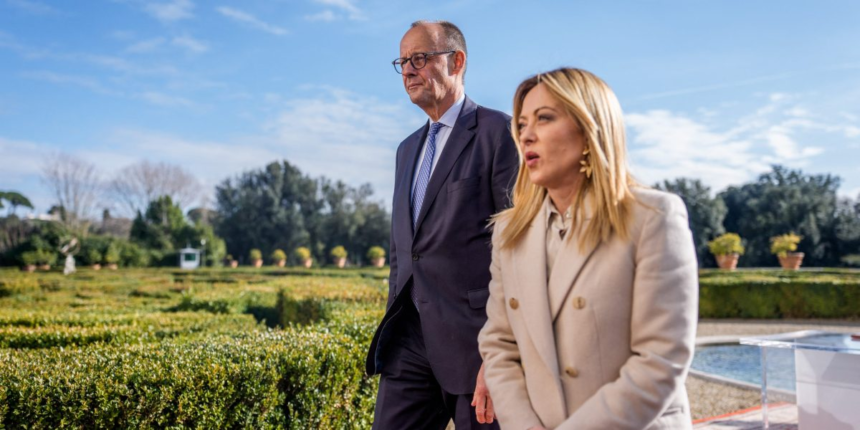
“Merzoni” isn’t a neologism that easily trips off the tongue, and it hasn’t fully taken hold in the world of European politics.
But times have changed.
Into this vacuum stepped Merz and Meloni. At first glance, the pairing looks odd.
What unites Merz and Meloni is less ideology than necessity.
Germany remains Europe’s economic engine but needs partners to push Europe toward greater defense capacity and economic competitiveness. Italy is seeking greater influence and credibility at Europe’s core.
Ironically, Europe’s unity has often emerged in response to crisis.
For leaders like Merz and Meloni, this creates political space for policies that would have seemed unthinkable, or certainly more difficult, a decade ago, such as military buildups, defense integration, industrial protection and tougher migration policies.
The move reflects a shared push by Berlin and Rome to strengthen Europe’s military capacity while anchoring rearmament in European industrial partnerships.
At the same time, Meloni can present herself as both nationalist at home and indispensable to Europe. Her political positions allow her to maintain channels with Washington while remaining inside EU consensus – a balancing act few European leaders can manage.
Germany, meanwhile, gains political flexibility and a partner more aligned with big-picture EU politics.
The Merzoni partnership faces major tests.
Yet necessity often drives European integration. And as crises accumulate, cooperation becomes less optional.
The real question is whether Europe can move from reactive crisis management to having a proactive geopolitical strategy. For now, the unlikely German-Italian partnership suggests Europe’s political map is being redrawn – not through grand federal visions but through pragmatic alliances shaped by fear, necessity and opportunity.