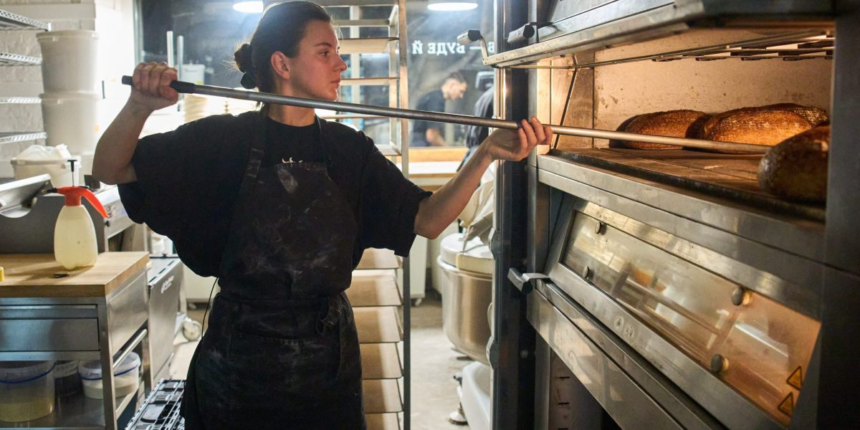
It is pre-dawn in the historic Podil district of the Ukraine capital, Kyiv, and warm light from the Spelta bakery-bistro’s window pierces the darkness outside. On a wooden surface dusted with flour, the baker Oleksandr Kutsenko skilfully divides and shapes soft, damp pieces of dough. As he shoves the first loaves into the oven, a sweet, delicate aroma of fresh bread fills the space.
“It’s now more than impossible to imagine a Ukrainian business operating without a generator,” said Olha Hrynchuk, the co-founder and head baker of Spelta.
Production is entirely dependent on electricity and the generator burns about 700 hryvnias ($16) worth of fuel per hour.
“We run on a generator for 10 to 12 hours a day. You have no fixed schedule — you have to adapt and refuel it at the same time,” Hrynchuk said.
The “Best Way to Cup” project, which has two venues and roasts and grinds its own coffee, is on the brink of permanent closure. Co-founder Yana Bilym, 33, who opened the cafe in May, said a Russian attack shattered all its windows and glass doors in August. Bilym said the cost of renovation was 150,000 hryvnias (about $3,400), half of which she financed with a bank loan that she only recently finished repaying.
Last month, after several consecutive large-scale Russian attacks on the energy sector, her entire building lost its water supply, and soon after the sewer system stopped working.
“We were forced to close. We believe it’s temporary. Businesses in December and January, unfortunately, operate at a loss,” Bilym said.
Now she has to regularly check the coffee machine and the specialty refrigerators, which she fears may not withstand the cold. Bilym hopes the closure is short-term. Her husband volunteered to serve in the military on the front line and she wants him to have somewhere to come back to when he returns to civilian life.
Many businesses have become a lifeline for communities struggling with plunging temperatures. Ukraine’s government has allowed some firms to operate during curfew hours in the energy emergency as “Points of Invincibility,” allowing access to free electricity to charge phones and power banks, drink tea and have some respite from the cold.
Tetiana Abramova, 61, is a founder of the Rito Group, a clothing company that has been producing designer knitwear for men and women since 1991, the year Ukraine became independent.
It participates in Ukraine Fashion Week, the country’s biggest fashion show, and exports garments to the United States. Abramova took out a loan in 2022 to purchase a powerful 35-kilowatt generator costing 500,000 hryvnias ($11,500) to keep the business running during blackouts and a wood-fired boiler for heating.
“At work we have heat, we have water, we have light — and we have each other,” she said.
But it’s not easy. Operating on generators is 15%–20% more expensive than using regular electricity. As a result, production costs are currently about 15% higher than normal. Added to that, customer numbers have dropped by about 40% as many people have left the country, so the focus is now on attracting new clients through online sales.
Abramova, an entrepreneur with more than 30 years of experience, says she spent nearly 100,000 hryvnias ($2,300) over two months on generator servicing to maintain production. But she cannot pass all those costs on to retailers.
“For us now, the main goal is not to be the most efficient, but to survive,” Abramova said.