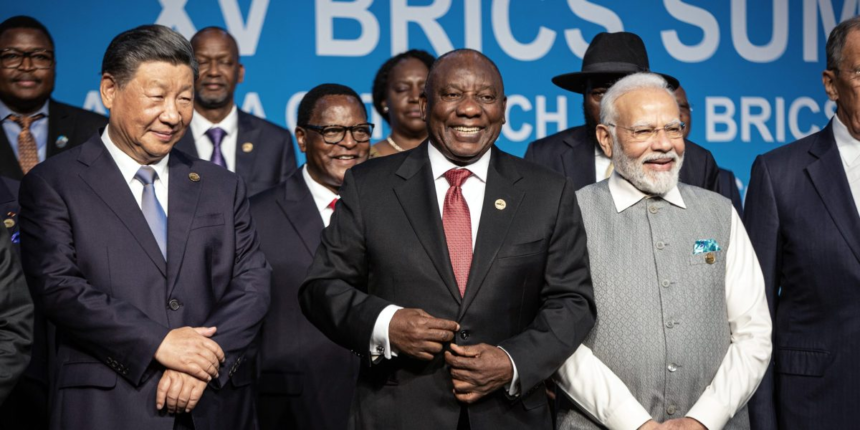
BRICS has come a long way since Goldman Sachs economist Jim O’Neill thought it up in 2001. As of January, it now comprises ten countries: the original five of Brazil, Russia, India, China and South Africa, and five new additions in Egypt, Ethiopia, Indonesia, Iran, and the United Arab Emirates.
But the primary threat to BRICS isn’t Trump, NATO, or the West. Instead, it comes from within: That BRICS expands too quickly and becomes incohesive, and that it underdelivers on its promise to reform global governance.
Enlargement may look pretty on paper, but BRICS needs ground rules, enforcement, and even just a common message. The bloc must address some pressing internal issues if it’s going to maintain he strategic clout and momentum it’s gained over recent years.
First, it needs to manage deep internal rivalries, particularly China and India, its two largest members. The two have sought to set a floor under their relationship, since Chinese President Xi Jinping and Indian Prime Minister Narendra Modi’s meetings in Kazan, Russia and Tianjin, China. Yet the relationship is still fraught with tension regarding longstanding territorial dispute; the most recent flare-up happened after an Indian citizen born in Arunachal Pradesh, which China claims as its territory, was detained in Shanghai’s airport for 18 hours.
Second, BRICS needs to balance economic security with members’ political goals. Beijing may view BRICS as an effective way to expedite investments into projects in West Asia, Central Asia, and the Indian Ocean, yet India, long wary of the Belt and Road Initiative, is skeptical of this infrastructure expansion. Pakistan is keen to join the New Development Bank, the BRICS’s development finance institution. Yet with India as BRICS’s chair this year, it’s unlikely that Pakistan’s application will proceed smoothly, as New Delhi will be wary to endorse funding for its longtime rival.
Admittedly, BRICS was never meant to resolve all the disagreements between its members. Yet the organization has also missed several opportunities to genuinely advance cooperation between its members, outside of the structures set up by the West.
For example, the bloc established the Contingent Reserve Arrangement (CRA) to provide currency swaps during foreign-exchange shortages. Yet the CRA also stipulates that members must abide by IMF conditions if they want access to over 30% of total entitlements. Ironically, that pushed South Africa to opt for the more resourceful and flexible IMF over the CRA, when it needed to secure a controversial $4.3 billion loan in 2020.
In theory, BRICS’s flexibility should be an asset, allowing it to accept members from across the geopolitical spectrum. Yet without a way to coordinate governments, enforce regulations and punish compliance, the bloc is, fundamentally, toothless.
Without a clear remit or binding guidelines, these “teething problems” can snowball into something more substantial.
Then add the fact that many current and prospective BRICS nations–like Indonesia, India and the UAE–are constantly trying to court U.S. investment and bolster security partnerships. Brazil, which has butted heads with Washington since Trump started his second term yet faces a White House keen on doubling down on its strategic influence and leverage in Latin America, will be wary of committing fully to just one bloc.
And some members are beset by internal problems. If, under intense American pressure and the existing large-scale protests, Iran further destabilizes, this will certainly affect the passage of India- and China-bound oil through the Strait of Hormuz, epitomizing how one country’s problems can very quickly affect the entire group.
If BRICS is going to be more than just an acronym, members have to see themselves as partners in a collective enterprise. That, in turn, will come from developing and accepting common ground rules that can be enforced. Otherwise, BRICS’s unbridled enlargement could end up being its undoing.
The opinions expressed in Fortune.com commentary pieces are solely the views of their authors and do not necessarily reflect the opinions and beliefs of Fortune.