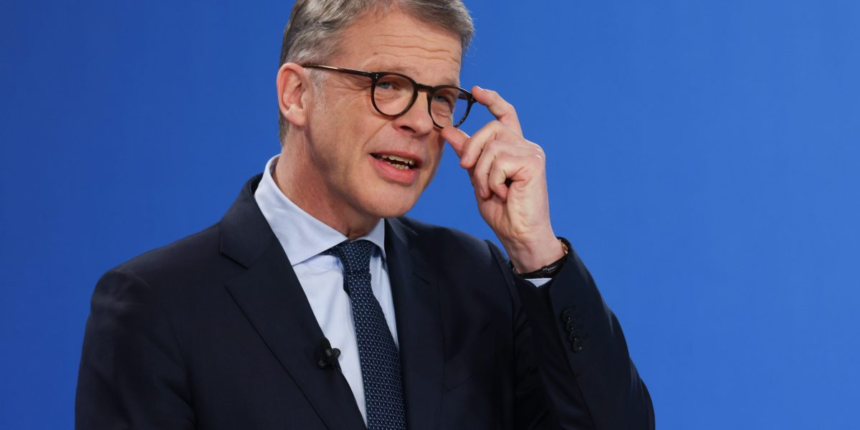
The morning after the raid, Deutsche Bank announced its highest annual profit since 2007: $8.5 billion net profit in 2025, powered by robust investment banking revenues. CEO Christian Sewing also unveiled a more than $1 billion share-buyback program and signaled confidence in the bank’s turnaround.
“We confirm that the Frankfurt public prosecutor’s office was on site in our offices on Wednesday. This is related to transactions dating back to the period 2013-2018. It is based on an allegedly late filing of a suspicious activity report,” a spokesperson for Deutsche Bank told Fortune. “On this basis, the prosecutor is assessing whether there was any potential money laundering. We are of course fully cooperating with the public prosecutor’s office.”
Although Sewing was not CEO during the time in question, having taken the helm of Deutsche Bank in April 2018, he has been a member of the lender’s executive board since 2015.
Deutsche Bank previously denied wrongdoing in a statement to Fortune. “As disclosed in our Annual Report, the bank has been aware that five individuals have threatened to file claims in the U.K. in the context of this matter. Deutsche Bank considers all such claims to be entirely without merit and will defend itself against them robustly,” a Deutsche Bank spokesperson said, emphasizing that Sewing was not named in the latest London legal filing.
David Zaring, a business ethics and law professor at Wharton, said Wednesday’s raid makes him wonder if Deutsche Bank will ever get out from under its past. “They’ve paid a lot of fines, and a lot of fines for money laundering in particular, as well as wider compliance areas,” he told Fortune, “It’s fair to say that they have had a compliance problem. And I’m guessing that they hoped they’d solved some of those problems already.”
Frankfurt prosecutors confirmed they are investigating “unknown responsible parties and employees” over suspected money laundering connected to transactions between 2013 and 2018.
Under Sewing’s leadership, the bank has made considerable investments in strengthening controls, including bolstering anti-financial-crime processes through technology, training, and additional specialized staff, a Deutsche Bank spokesperson told Fortune last year. Regulatory investigations since 2020 have resulted in compliance reforms, and the bank has terminated numerous high-risk client relationships.
But the latest raid stands to remind the German lender how long the tail of compliance failures can extend.
“Deutsche Bank had it worse from 2013 to 2018. But this does make it look like they’re back in the situation they were in 10 years ago,” Zaring told Fortune. “And I don’t think anyone wants that.”