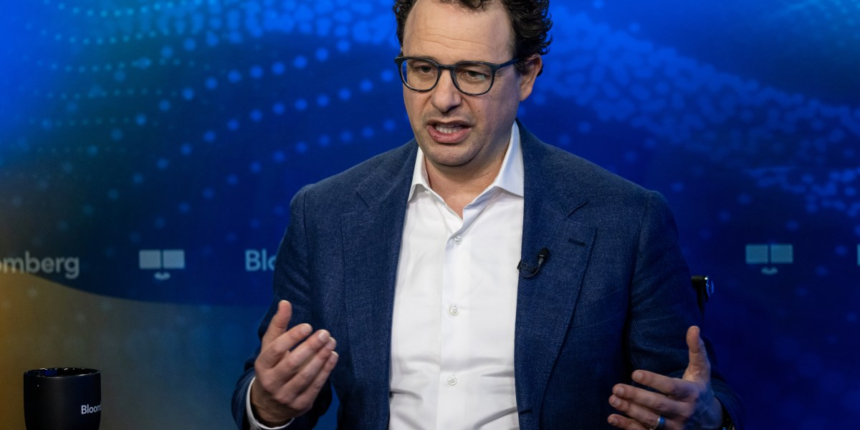
One thing Amodei said in his essay is that 50% of entry level white collar jobs will be eliminated within one to five years due to AI. He said the same thing at Davos last week. But, talking to C-suite leaders there, I got the sense that few of them concur with Amodei’s prognostication.
Amodei has been off about the rate at which technology diffuses into non-AI companies before. Last year, he projected that up to 90% of code would be AI-written by the end of 2025. It seems that this was, in fact, true for Anthropic itself. But it was not true for most companies. Even at other software companies, the amount of AI-written code has been between 25% and 40%. So Amodei may have a skewed sense for how quickly non-tech companies are actually able to adopt technology.
Kumar, the CEO of Cognizant, told me that he sees four keys to realizing significant ROI from AI. First, companies need to reinvent all of their workflows, not simply try to automate a few pieces of existing ones. Second, they need to understand context engineering—how to give AI agents the data, information, and tools to accomplish tasks successfully. Third, they have to create organizational structures designed to integrate and govern both AI agents and humans. And finally, companies need a skilling infrastructure—a process to make sure their employees know how to use AI effectively, but also a retraining and career development pipeline that teaches workers how to perform new tasks and functions as AI automates existing tasks and transforms existing workflows.
What’s key here is that none of these steps is simple to accomplish. All take significant investment, time, and most importantly, human ingenuity to get right. But Kumar thinks that if companies get this right, there is $4.5 trillion worth of productivity gains waiting to be grabbed in the U.S. alone. He said these gains could be realized even if AI models never become any more capable than they are today.
Ok, with that, here’s more AI news.
Fortune’s Beatrice Nolan wrote the news and research sections of this newsletter below. Jeremy wrote the Brain Food item.