“And so that’s the sort of control the president is pointing to when he says that,” Rubio said on CBS’ “Face the Nation.” “We continue with that quarantine, and we expect to see that there will be changes, not just in the way the oil industry is run for the benefit of the people, but also so that they stop the drug trafficking.”
Leaders in Venezuela have so far pushed back, at least publicly, calling on the Trump administration to release Maduro.
Trump’s vow to “run” Venezuela, repeated more than half a dozen times at a news conference in Florida on Saturday, sparked concerns among some Democrats. It also drew unease from parts of his own Republican coalition, including an “America First” base that is opposed to foreign interventions, and also from observers who recalled past nation-building efforts in Iraq and Afghanistan.
Rubio dismissed such criticism, saying that Trump’s intent had been misunderstood.
“The whole foreign policy apparatus thinks everything is Libya, everything is Iraq, everything is Afghanistan,” Rubio said. “This is not the Middle East. And our mission here is very different. This is the Western Hemisphere.”
Rubio also suggested the U.S. would give Maduro’s subordinates now in charge time to govern, saying, “We’re going to judge everything by what they do.” And though he did not rule out boots on the ground in Venezuela, Rubio said the U.S, which has built up its presence in the region, was already capable of stopping drug boats and sanctioned tankers.
A day earlier, Trump told reporters, “We’re going to run the country until such time as we can do a safe, proper and judicious transition.” He later pointed to his national security team with him, including Rubio and Defense Secretary Pete Hegseth, and said it would be done for a period of time by “the people that are standing right behind me. We’re gonna be running it we’re gonna be bringing it back.”
The White House declined to comment beyond what Trump said Saturday.
Maduro is due to make his first appearance Monday in Manhattan’s federal court.
The presidential palace was guarded by armed civilians and members of the military. At a nearby plaza, only a street sweeper and a soldier stood, and across the street, a church remained close for a second day in a row.
Under Venezuelan law, Rodríguez would take over from Maduro. Rodriguez, however, stressed during a Saturday appearance on state television that she did not plan to assume power, before Venezuela’s high court ordered that she assume the interim role. Trump told The Atlantic in an interview Sunday that Rodríguez could “pay a very big price” if she doesn’t do what he thinks is right for Venezuela.
That contrasted with the Republican president’s comments about Rodríguez on Saturday when he said Rubio had spoken with her and she was willing to do what the U.S. thinks is needed to improve the standard of living in Venezuela.
Trump told the magazine that “if she doesn’t do what’s right, she is going to pay a very big price, probably bigger than Maduro.”
Trump told the New York Post in an interview Saturday that the U.S. wouldn’t need to station troops in Venezuela if she “does what we want.”
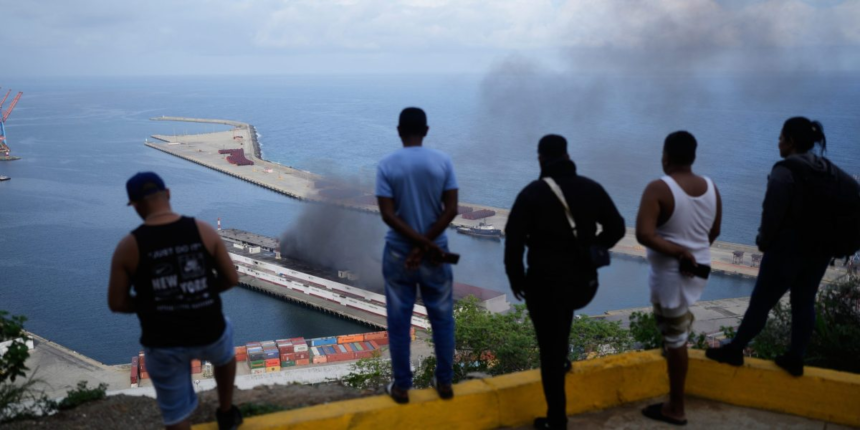
Caracas resident David Leal arrived to the lot where he parks vehicles for a living only to quickly realize that he would likely not see any clients for a second day.
“People are still shaken,” said Leal, 77.