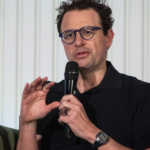
“One of the things that really surprises me consistently is how scared our students are of using it,” Anthony said. He clarified this anxiety isn’t merely about academic integrity or cheating. Plenty of his students are excited to use AI and push into the frontier of this new tech advance, he clarified, but a meaningful portion approach it with “hesitation and fear.” They are “scared full stop.”
Anthony said what he believes about studying disruption, and managing through it as a consultant, is that you look back later on and the pattern becomes clear, but at this particular stage, “there’s just a lot of noise.” He said he understands his students’ concerns about AI and shares it to some extent—offloading too much cognitive work to AI will atrophy the critical thinking skills required to lead.
“I’ve been teaching a class about how you lead disruptive change,” Anthony said, adding he wants to find someone who needs to learn a particular topic and use AI to tackle that. This doesn’t mean he wants something like, say, an AI-driven song that required one prompt to make. “I want you to actually go and expose the guts of the work that you did so I can then go and see whether you learned anything or not.” Sometimes, he said, elegant outputs are the result from students who didn’t learn anything, but he also gets “rough outputs where when you see what they’re actually doing.”
He agreed with Leskovec some changes are already irreversible: “The writing is all good now. The bad writing has been taken out.” This can be “dangerous,” he added, saying he really pushes his students to resist temptation.
“The thing I’ve just really been pushing, whether it’s students or whether it’s the executives that I’ve been working with, it’s so seductive and easy to say, ‘Let me offload,’” he said. The reason why, he explained, has to do with what he learned about Jerry Seinfeld and Julia Child while researching his book.
Seinfeld was making the point, Alexander told Fortune, that the hard way to be funny is the right way, at least for him. He said he wants students to do the “hard work” to develop the wisdom necessary to manage AI effectively.
“We just have to separate people from technology when we’re assessing learning or else we’re going to get AI regurgitation,” he warned. That can be useful for some things, “but if you’re trying to figure out whether people learn something or not, it’s useless.”
Anthony also drew on a fitness analogy: “You go to the gym, you want to lift any amount of weight, bring a forklift with you. You can lift the weight, but that’s not the point.”
Anthony said his research, teaching at the Tuck School of Business, and his writing shows people are getting bogged down by AI when they should be focused on the hard work Seinfeld was referencing. Take the example of the famous cooking author Julia Child, which Anthony said was his favorite chapter of the book because it was the most surprising. The lesson he drew from it is that you may not be able to be the next Steve Jobs, but you could be the next Julia Child. “If life bounces the right way, I could imagine that happening to me, you know?”
The professor explained Child’s example shows disruption “isn’t about being a superhero,” but it’s more about ordinary people following certain behaviors and showing curiosity.
Consider the first French meal that Child cooked for her husband, Anthony said: brain, simmered in red wine. “Everybody agreed it was a disaster.” But again, he said, the hard work was the point.