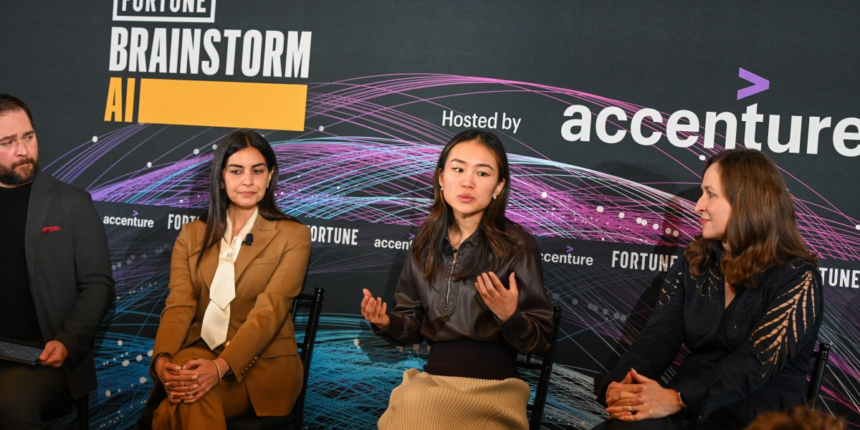
With AI agents handling more tasks, Xu said that workers will shift “from producers to more directors.” Instead of asking, “How do I accomplish the goal?” they’ll instead focus on, “What are the goals that I want to accomplish, and then how do I delegate those goals to AI?” she said.
Creative and sales professionals are increasingly anxious about AI automation as tools like chatbots and AI image generators have proved to be good at doing many creative tasks in sectors like marketing, customer service, and graphic design. Companies are already deploying AI agents to take on tasks like handling customer questions, generating marketing content, and assisting with sales outreach.
As AI takes on some of these lower-level tasks, Zornes said, workers can focus on more creative projects.
“With AI, the floor has been raised, but so has the ceiling,” she added. “We have an opportunity to create more, to be more imaginative.”
The shift to AI-augmented work may not benefit all workers equally, however.
Salesforce’s Xu said AI’s impact won’t be evenly distributed between high and low performers. “The near-term impact of AI will largely be that we’re going to take the bottom 50 percentile performers inside a role and bring them into the top 50 percentile,” she said. “If you’re in the top 10 percentile, the superstar salespeople, creatives, the impact of AI is actually much less.”
While leaders were keen to emphasize that AI will augment, rather than replace, creative workers, the shift could reshape some traditional career ladders and impact workforce development. If AI agents handle entry-level execution work, companies may need to hire fewer people, and some learning opportunities may disappear for younger workers.
“We can build the most robust technology solution and consider it the Ferrari,” she said. “But if the culture and the organization of people are not enabled in terms of how to use that, that Ferrari is essentially stuck in traffic.”
Read more from Brainstorm AI: