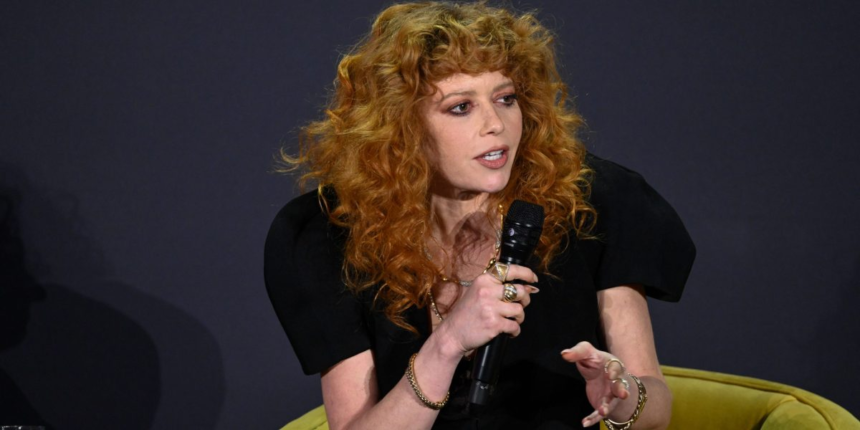
The actress, director, and wild-style futurist Natasha Lyonne is fascinated by technology. She speaks of the beauty and power of interstellar travel and muses about living long enough to walk a Hollywood red carpet as a reanimated cyborg.
But she also has a grave concern, she explained to the Fortune Brainstorm AI audience on Monday in San Francisco: With all this boundless possibility, why is AI focused on replacing screenwriters instead of, say, figuring out a solution to fixing plastic bottles polluting the oceans? “I don’t think that’s an accident,” said Lyonne, 46. “It’s about cutting costs.”
Her rallying cry to C-suites and AI leaders—delivered in her signature wry, New York City accent—is to think really hard about what it means to be human in this age where AI is all the rage, and act accordingly. “We are the ones who are deciding what this use is going to be and how we choose to use it,” Lyonne said. “I really want this to mean a seat at the table for more people to do even more extraordinary things.”
Lyonne, who has been in the film business since she was a child actor, pointed out that it takes enormous human legwork—from casts, crews, and everyone from drivers to the creatives who bring ideas onto screens—to keep film and television plodding forward. AI companies that scrape content without permission or payment are neglecting that entire ecosystem, she said. “So I don’t think it’s super-kosher copacetic to just kind of rob freely under the auspices of acceleration or China, right?”
As a child, she said, she studied Talmudic texts and interpretations in Aramaic—the ancient language used in Talmudic writings. The complexity in exploring layers of meaning and iterations of theory now informs her approach to AI in filmmaking, she said.
Lyonne said she dropped out of New York University to pursue a self-taught education in film at indie movie theater Film Forum. When asked what advice she’d give her younger teenage self, Lyonne suggested mastery of the kind that takes 10,000 hours of work to develop. “Really, really learn these tools,” she said. “It’s really about technique, and that takes a long time … That’s how you learn how to write and all that.”
The beauty of mastering a skill and knowing how to think and create is that then you can break those rules, said Lyonne. “I’m not so much interested in raging against the machine,” she said. “I’m interested in building new houses, new seats at the table.”