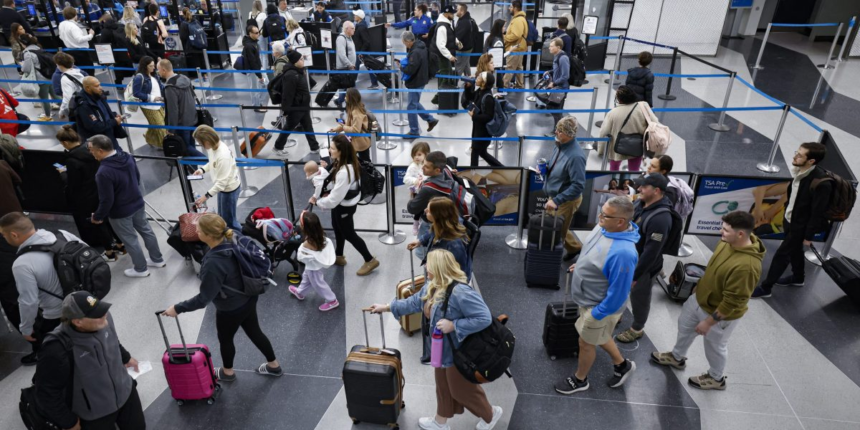
Here’s a guide to navigating the busiest travel week of the year:
Travel forecasts point to packed airports and roads.
AAA projects 1.3 million more travelers will be on the roads than last year, pushing the total number of people traveling by car to at least 73 million.
You can’t control the weather, but you can control how prepared you are if a winter storm hits. If your flight is canceled or delayed, will you drive instead or postpone or cancel your trip? Knowing your options ahead of time can reduce stress if a storm leaves you stranded.
James Belanger, vice president of meteorology at the Weather Company, recommends checking the forecast frequently while planning your trip.
On Tuesday, the FAA’s busiest day with more than 52,000 flights scheduled, forecasters say rain could cause problems in the Pacific Northwest and for much of the eastern U.S. Airports in Atlanta, Chicago, New York, Philadelphia, Seattle and Washington, D.C., could be impacted, according to the Weather Channel.
Jacobson, whose research contributed to the design of TSA PreCheck, recommends starting your packing by unpacking.
Check every pocket in case TSA-restricted items, like full-sized bottles, were left behind from a previous trip. This simple scan can help you get through security faster, especially when airports are crowded.
If you’re traveling with gifts, Jacobson suggests wrapping them at your destination because TSA agents may need to open them.
When deciding which clothes and shoes to pack, Belanger says to check the “feels like” temperature for a better sense of the weather, especially if you’re not used to the cold.
Whether driving is your top choice or backup plan, AAA spokesperson Aixa Diaz suggests checking your tires, car battery and fluids, then hitting the road with a full tank of gas as early as possible to avoid traffic. Last year, AAA said, it responded to nearly 600,000 emergency roadside assistance calls during the Thanksgiving travel period to help drivers stranded by dead batteries, flat tires and empty tanks.
— Traffic on Wednesday is expected to be 14% heavier than usual between 10 a.m. and 4 p.m., with peak traffic from 1 p.m. to 3 p.m.
— On Thanksgiving Day, the roads will be busiest between noon and 3 p.m.
— When it’s time to head home, avoid driving from 12 to 3 p.m. on Saturday and Sunday, when traffic is heaviest.
“…is an informed passenger,” Jacobson likes to say.
Download your airline’s app to track your flight status, and check it regularly as your travel date approaches. That way, if your flight is canceled the day before, you can quickly look for alternatives.
Driving or flying, leave earlier than you think you need to. Knowing you won’t have to rush to your destination can help calm any nerves, whether it’s lingering anxiety from the shutdown or because you’re traveling with young kids or someone who needs extra help getting around.
“These are some very simple things to think about, but they’re important things to think about,” Jacobson said.