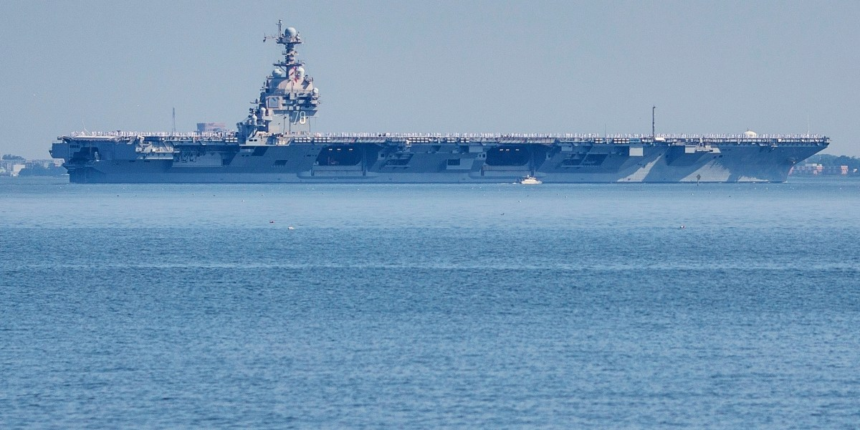
The carrier strike group, which includes squadrons of fighter jets and guided-missile destroyers, transited the Anegada Passage near the British Virgin Islands on Sunday morning, the Navy said.
Rear Adm. Paul Lanzilotta, who commands the strike group, said it will bolster an already large force of American warships to “protect our nation’s security and prosperity against narco-terrorism in the Western Hemisphere.”
Adm. Alvin Holsey, the commander who oversees the Caribbean and Latin America, said in a statement that the American forces “stand ready to combat the transnational threats that seek to destabilize our region.”
In Trinidad and Tobago, which is only 7 miles from Venezuela at its closest point, government officials said troops have begun “training exercises” with the U.S. military that will run through much of the week.
Minister of Foreign Affairs Sean Sobers described the joint exercises as the second in less than a month and said they are aimed at tackling violent crime on the island nation, which has become a stopover point for drug shipments headed to Europe and North America. The prime minister has been a vocal supporter of the U.S. military strikes.
The exercises will include Marines from the 22nd Expeditionary Unit who have been stationed aboard the Navy ships that have been looming off Venezuela’s coast for months.
Venezuela’s government has described the training exercises as an act of aggression. It had no immediate comment Sunday on the arrival of the aircraft carrier.
Meanwhile, Army Secretary Dan Driscoll said Sunday that U.S. troops have been training in Panama, underscoring the administration’s increasing focus on Latin America.
“We’re reactivating our jungle school in Panama. We would be ready to act on whatever” Trump and Defense Secretary Pete Hegseth needed, he told CBS’ “Face the Nation.”
Maduro, who faces charges of narcoterrorism in the U.S., has said the U.S. government is “fabricating” a war against him. On his Facebook page, Maduro wrote on Sunday that the “Venezuelan people are ready to defend their homeland against any criminal aggression.”
Venezuela’s government recently touted a “massive” mobilization of troops and civilians to defend against possible U.S. attacks. Maduro and other officials in Venezuela’s socialist party also have been attending rallies this weekend to back the creation of neighborhood committees that will be in charge of increasing membership in Venezuela’s socialist party, and promoting the party’s policies.
Experts disagree on whether or not American warplanes may be used to strike land targets inside Venezuela. Either way, the 100,000-ton warship is sending a message.
“This is the anchor of what it means to have U.S. military power once again in Latin America,” said Elizabeth Dickinson, the International Crisis Group’s senior analyst for the Andes region. “And it has raised a lot of anxieties in Venezuela but also throughout the region. I think everyone is watching this with sort of bated breath to see just how willing the U.S. is to really use military force.”