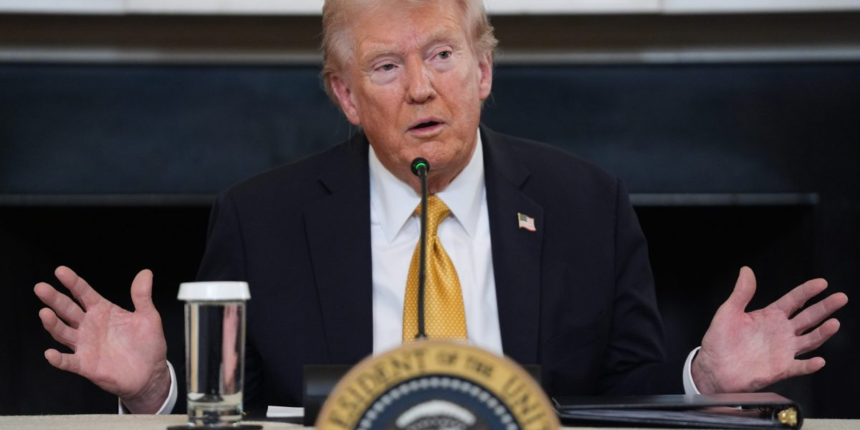
“We’ve been doing that for 30 years,” he said last month, “and it’s been totally ineffective.”
Trump’s comments came around the same time that the U.S. Coast Guard announced it had set a record for cocaine seizures — a haul of 225 metric tons of the drug over the previous year. That milestone, however, has not dissuaded the Republican president from upending decades of U.S. counternarcotics policy.
Veterans of the drug war, meanwhile, say U.S. resources would be better spent doubling down on the traditional approach of interdicting drug boats, especially in the long term. That is because crews of drug boats frequently have valuable intelligence that can help authorities better target cartels and trafficking networks. Dead men, they say, tell no tales.
The Coast Guard for decades has interdicted small vessels suspected of smuggling illicit narcotics. Much of that work is focused on halting shipments of cocaine, most of which is produced in the jungles of Colombia.
Working with partner nations and other federal agencies — the Drug Enforcement Administration, the departments of State and Justice as well as U.S. Southern Command’s Joint Interagency Task Force-South in Key West, Florida — the aim is to inflict heavy losses on traffickers and limit the amount of drugs entering the U.S.
That campaign, by at least one measure, has never been more successful, despite constant complaints by the Coast Guard that it lacks funding to seize even more drugs.
The Coast Guard’s recent record cocaine seizure was almost 40% higher than the past decade’s annual average. The haul included 38 tons of cocaine offloaded by the cutter Hamilton when it returned from a two-month patrol. It was the largest amount confiscated by a single Coast Guard ship during a deployment, the Coast Guard reported. The interdictions have continued as part of what’s known as Operation Pacific Viper even during the federal government shutdown, with several cutters reporting major seizures last month.
“The Coast Guard has extraordinary powers and authorities to do effective drug interdiction without killing unidentified people on small boats,” said Douglas Farah, a national security expert on Latin America and president of IBI Consultants. “When resourced, they are far more effective, sustainable and likely legal than the current Pentagon-led operations.”
Secretary of State Marco Rubio this week defended the shift in strategy, saying that “interdictions alone are not effective.”
“Interdictions have limited to no deterrent effect,” he added. “These drug organizations, they’ve already baked in the fact they may lose 5% of their drug shipments. It doesn’t stop them from coming.”
Part of the problem is that demand for cocaine is high, and supplies have never been so robust, according to authorities and experts. A sign of that trend: Cocaine prices have been hovering at historical lows for more than a decade.
The Coast Guard also does not have enough vessels or crew to halt it all. At most, it seizes not even 10% of the cocaine that officials believe flows to the U.S. on small vessels through what is known as the “Transit Zone” — a vast area of open water larger than Russia.
Cocaine shipments bound for the U.S. primarily work their way up the west coast of South America to Central America and then overland into the U.S. via Mexico. Shipments heading to Europe are smuggled through the Caribbean, often hidden in container ships.
In social media posts, Trump has claimed that his strikes have blown up boats carrying fentanyl and that each destroyed vessel has saved 25,000 American lives. According to experts and former U.S. counternarcotics officials, Trump’s statements are either exaggerations or false.
The drug flowing to the U.S. from South America is cocaine. Fentanyl, on the other hand, is typically trafficked to the U.S. overland from Mexico, where it is produced with chemicals imported from China and India. Cocaine overdose deaths are less frequent than those from fentanyl. In the last year, just under 20,000 people in America died from cocaine overdoses, federal data shows.
Trump and administration officials have also claimed that the crews of targeted vessels were narco-terrorists or members of cartels.
Law enforcement officials and experts echoed those findings, saying the smugglers captured by the Coast Guard are hired for little money to ferry drugs from point A to point B.
“They are hardly kingpins,” said Kendra McSweeney, an Ohio State University geographer who has spent years researching U.S. drug policies.
In April, months before Trump launched his military campaign, his attorney general, Pam Bondi, traveled to South Florida to welcome home the Coast Guard cutter James from its latest antinarcotics patrol. It had seized 20 tons of cocaine worth more than $500 million.
Flanked by FBI Director Kash Patel, she praised a “prosecutor-led, intelligence driven approach to stopping these criminal enterprises in their tracks.”
“This is not a drop in the bucket,” said Bondi, standing in front of the vessel loaded with colorful, plastic-wrapped bales of narcotics stacked several feet high. “Behind you is half a billion dollars of pure, uncut cocaine.”