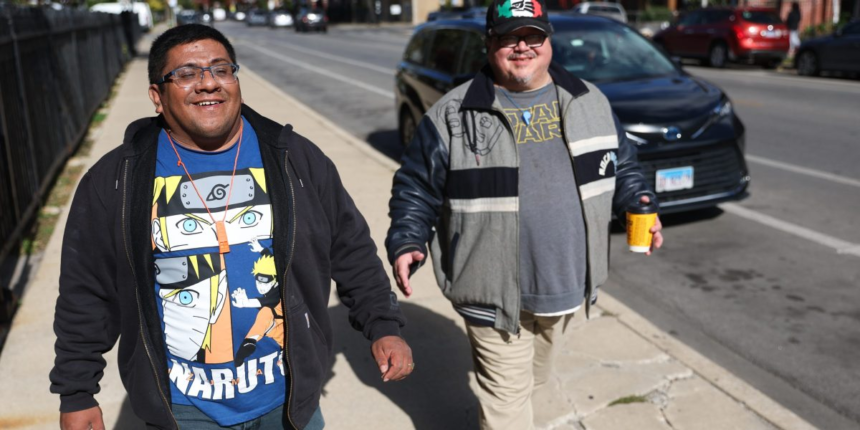
Wearing an orange whistle around his neck, the activist broadcasts his plans on Facebook.
“We don’t know if they’re going to come back. All we know is we’ve got to get ready,” he tells thousands of followers. “Give us any tips if you see any suspicious cars.”
Moments later, his phone buzzes.
“The strategy here is to make us afraid. The response from Chicago is a bunch of obscenities and ‘no,’” said Anna Zolkowski Sobor, whose North Side neighborhood saw agents throw tear gas and tackle an elderly man. “We are all Chicagoans who deserve to be here. Leave us alone.”
Perhaps the clearest indicator of Chicago’s growing resistance is the sound of whistles.
Enriquez is credited with being among the first to introduce the concept. For months Little Village residents have used them to broadcast the persistent presence of immigration agents.
Furious blasts both warn and attract observers who record video or criticize agents. Arrests, often referred to as kidnappings because many agents cover their faces, draw increasingly agitated crowds. Immigration agents have responded aggressively.
Activists say they discourage violence.
“We don’t have guns. All we have is a whistle,” Enriquez said. “That has become a method that has saved people from being kidnapped and unlawful arrest.”
By October, neighborhoods citywide were hosting so-called “Whistlemania” events to pack the brightly colored devices for distribution through businesses and free book hutches.
“They want that orange whistle,” said Gabe Gonzalez, an activist. “They want to nod to each other in the street and know they are part of this movement.”
Even with its 2.7 million people, Chicago residents like to say the nation’s third-largest city operates as a collection of small towns with Midwest sensibilities.
People generally know their neighbors and offer help. Word spreads quickly.
When immigration agents began targeting food vendors, Rick Rosales, enlisted his bicycle advocacy group Cycling x Solidarity. He hosted rides to visit street vendors, buying out their inventory to lower their risk while supporting their business.
Irais Sosa, co-founder of the apparel store Sin Titulo, started a neighbor program with grocery runs and rideshare gift cards for families afraid of venturing out.
“That neighborhood feel and support is part of the core of Chicago,” she said.
Enriquez’s organization, Little Village Community Council, saw its volunteer walking group which escorts children to school, grow from 13 to 32 students.
Many also credit the grassroots nature of the resistance to Chicago’s long history of community and union organizing.
So when hundreds of federal agents arrived in September, activists poured energy into an emergency hotline that dispatches response teams to gather intel, including names of those detained. Volunteers would also circulate videos online, warn of reoccurring license plates or follow agents’ cars while honking horns.
Delilah Hernandez, 16, was among dozens from Farragut Career Academy who protested on a school day.She held a sign with the Constitution’s preamble as she walked in Little Village. She knows many people with detained relatives.
“There is so much going on,” she said. “You feel it.”
The Department of Homeland Security defends the operation, alleging officers face hostile crowds as they pursue violent criminals.
But the operation’s intensity could subside soon.
DHS, which oversees CBP and Immigration and Customs Enforcement, has said operations won’t end in Chicago.
Alonso Zaragoza, with a neighborhood organization in the heavily immigrant Belmont Cragin, has printed hundreds of “No ICE” posters for businesses. Organizers in Oregon and Missouri have asked for advice.
“It’s become a model for other cities,” Zaragoza said. “We’re building leaders in our community who are teaching others.”
“We train and we let go, and the people of Chicago are the ones who run with it,” said organizer Jill Garvey.
Federal agents visited his home and questioned family members. A U.S. citizen relative was handcuffed by agents. His car horn no longer works, which he attributes to overuse.
“This has been very traumatizing,” he said. “It is very scary because you will remember this for the rest of your life.”