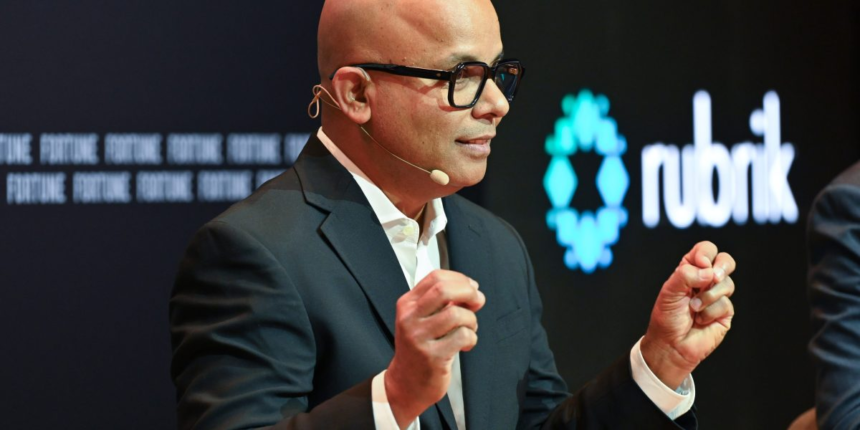
Over the past decade, “cyberattacks have gone from more innocuous attacks to really destructive ones,” Bipul Sinha, CEO of cybersecurity firm Rubrik, said Monday during a lunch session at the Fortune Global Forum in Riyadh, Saudi Arabia. (Rubrik is a partner of the Fortune Global Forum, and the host of Monday’s lunch session)
Cybercriminals can now use AI’s ability to customize content en masse to steal credentials. Previously, conducting a social engineering attack was “a very labor-intensive process,” requiring fraudsters to research a company’s strategy and write a compelling phishing email, Sinha said. “Now AI can conduct such customized attacks at scale.”
A more connected world is also opening up new avenues for attack. “We started with having to defend very simple core systems,” said Pieter Bil, managing director of Middle East and Africa for Kyndryl, a global IT infrastructure service provider. “But now we talk about IoT, AI cloud, working from home—all these things broaden the network.”
“In the middle of a heart attack, school shooting or sexual assault, people called 911 and the line was dead,” Martin said. “We’re talking about securing critical infrastructure against sophisticated adversaries that are no longer just a kid in a basement.”
“It’s not a fair game,” said Bil, from Kyndryl. “Attackers only need to be right once, but defenders need to be 100% right, and they need to be very quick.” That means it’s crucial for industry leaders to embrace AI, train the right people, and “get to the next level” with this new technology.
Governments have a role to play, said Ali Abulhasan, co-founder and CEO of Tap Payments, a Riyadh-based digital payments company. “We’re lucky to be operating in the Middle East and Saudi Arabia, specifically due to the high attention and proactiveness of the governmental bodies here towards cybersecurity,” he said.
“In the U.S., our challenge is that cybersecurity is not a field that our top engineers aspire to enter out of college. People are going into algorithmic designs, social media and advertisements,” Sinha said. “But the need for ‘grunt’ work will reduce with the introduction of AI, and that may excite new grads with computer science degrees to go into cybersecurity.”