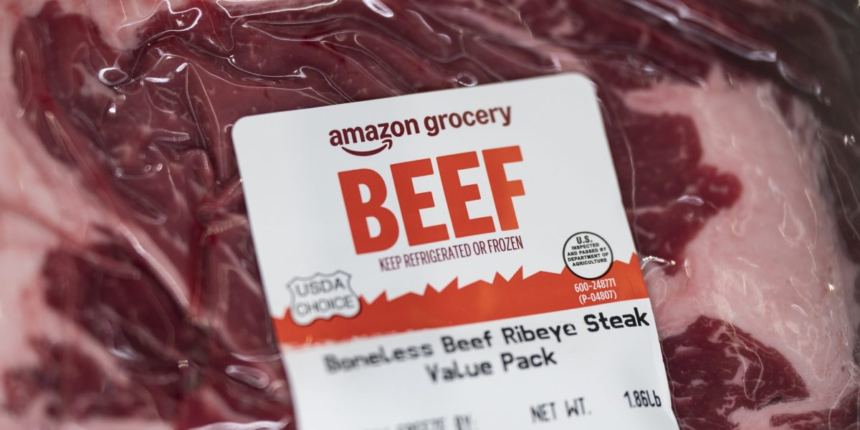
“The average consumer visits between four and five different retailers for groceries every single month,” the executive said in front of a smaller group of reporters later that day. What Amazon was doing, the executive claimed, was creating a one-stop shop that all customers crave. The obvious implication was that Walmart, the historical one-stop retail option, was not delivering on the promise.
“The reason this announcement is so significant,” Wedbush Securities’ Scott Devitt wrote in a research note on Wednesday, “is that Amazon has yet to displace incumbents in the grocery category, at least for perishables. Grocery is the biggest retail category and still relatively untouched by the internet.”
Indeed.
In an interview for my book, Winner Sells All, about the Amazon/Walmart rivalry, the current CEO of Amazon’s core consumer business, Doug Herrington, explained the appeal of the grocery category. “Selling a book or a TV is great and super helpful, [but] how many times do I buy a book or TV each week versus how many times do I buy a packaged goods item, or some toilet paper or some food?”
In short, if Amazon can start making a real dent in the grocery delivery market, customers will likely shop even more frequently at the internet giant. In fact, the company previously said that was the behavior it witnessed among customers in test markets last year.
“This deepens AMZN’s customer engagement by strengthening a high-frequency purchase category into the Prime ecosystem, increasing stickiness and customer lifetime value,” Evercore’s Mark Mahaney wrote of the same-day grocery rollout in a research note to clients on Wednesday. He said the service could pose a threat to Instacart as well as Walmart’s same-day delivery membership program, Walmart+.
The path to the grocery aisle has been a long and sometimes bumpy one for Amazon, with this week’s announcement marking the latest in a string of grocery-related launches, failures, and pivots over the past two decades. For those who’ve closely followed the company’s efforts in this area, Wednesday’s announcement might even feel like déjà vu. Amazon once ran a service called Prime Now that offered two-hour delivery on a limited selection of general merchandise, along with fresh and frozen groceries in around 100 U.S. metro areas. It was discontinued in 2021, with the company saying at the time that it was being folded into the main Amazon shopping platform.
Amazon also offers the Amazon Fresh grocery delivery service, geared toward larger grocery orders, which it actually began testing all the way back in 2007. The service has gone through countless business model tweaks over the years as leadership has attempted to strike a balance between a price that’s attractive to enough customers while still supporting a cost structure that is economically sustainable. Amazon also runs a chain of dozens of Amazon Fresh grocery stores, which has a gone through phases of retrenchment and expansion itself.
And of course, Amazon made its biggest grocery splash in 2017 when it spent nearly $14 billion to acquire the brick-and-mortar grocer Whole Foods, which now counts more than 500 locations.
Amazon offers unlimited grocery delivery from both Amazon Fresh and Whole Foods grocery chains at a cost of $9.99 a month on top of the core Prime membership fee.
Along the way, Amazon has seemed intent in recent years on dispelling the notion that it has failed in the grocery space. At the press event in the fall, an Amazon executive said, “What most people don’t realize is we already have a huge established grocery business online … Most of the selection today are things like pantry items and household goods or what we call everyday essentials.”
And on recent earnings calls, Amazon executives including CEO Andy Jassy have hammered home the messaging that this “everyday essentials” business is already a major player in the nonperishable grocery space. Company leaders recently disclosed that Amazon sold more than $100 billion in groceries and household, or everyday, essentials in 2024, not counting what sold through its Amazon Fresh and Whole Foods divisions.